

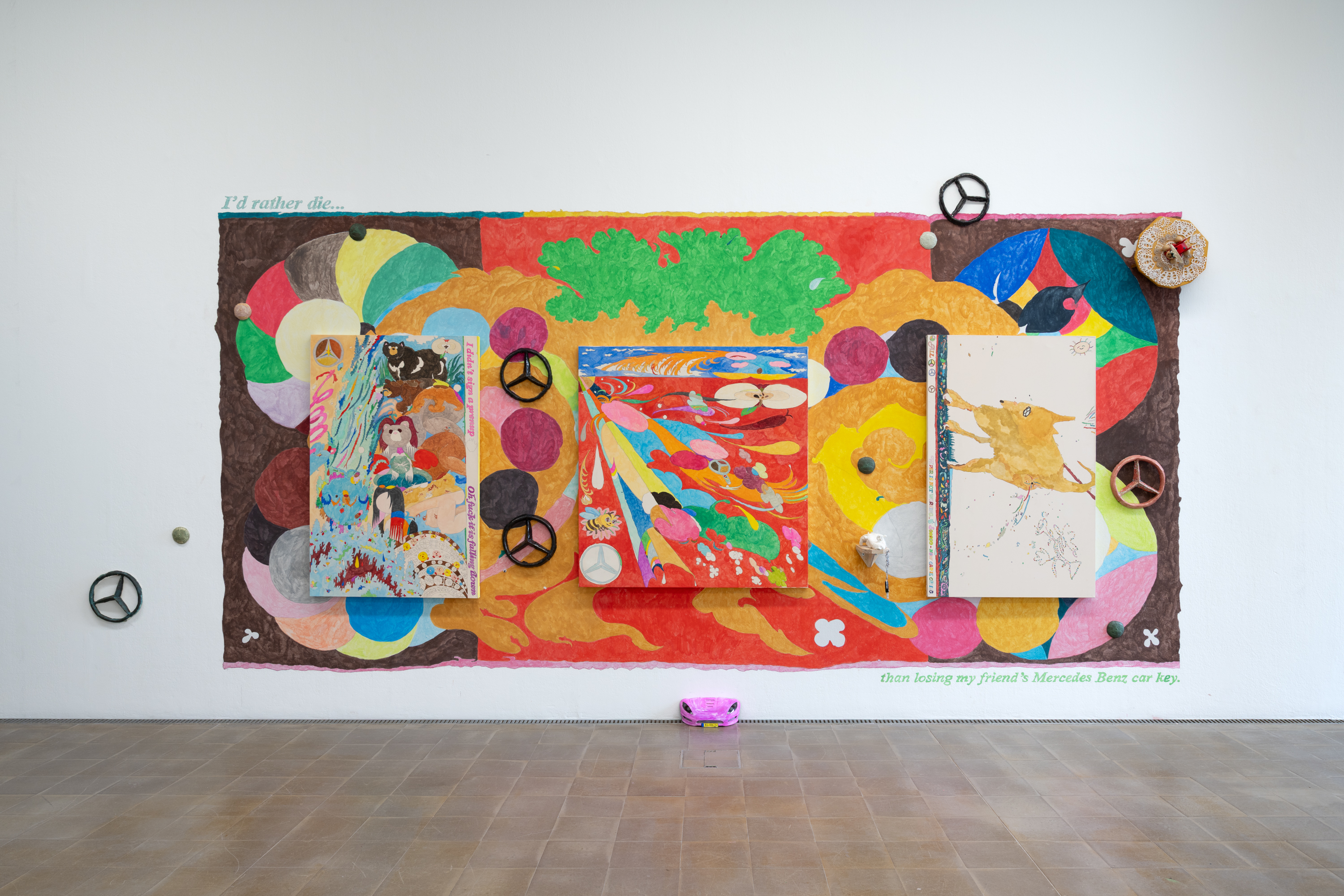
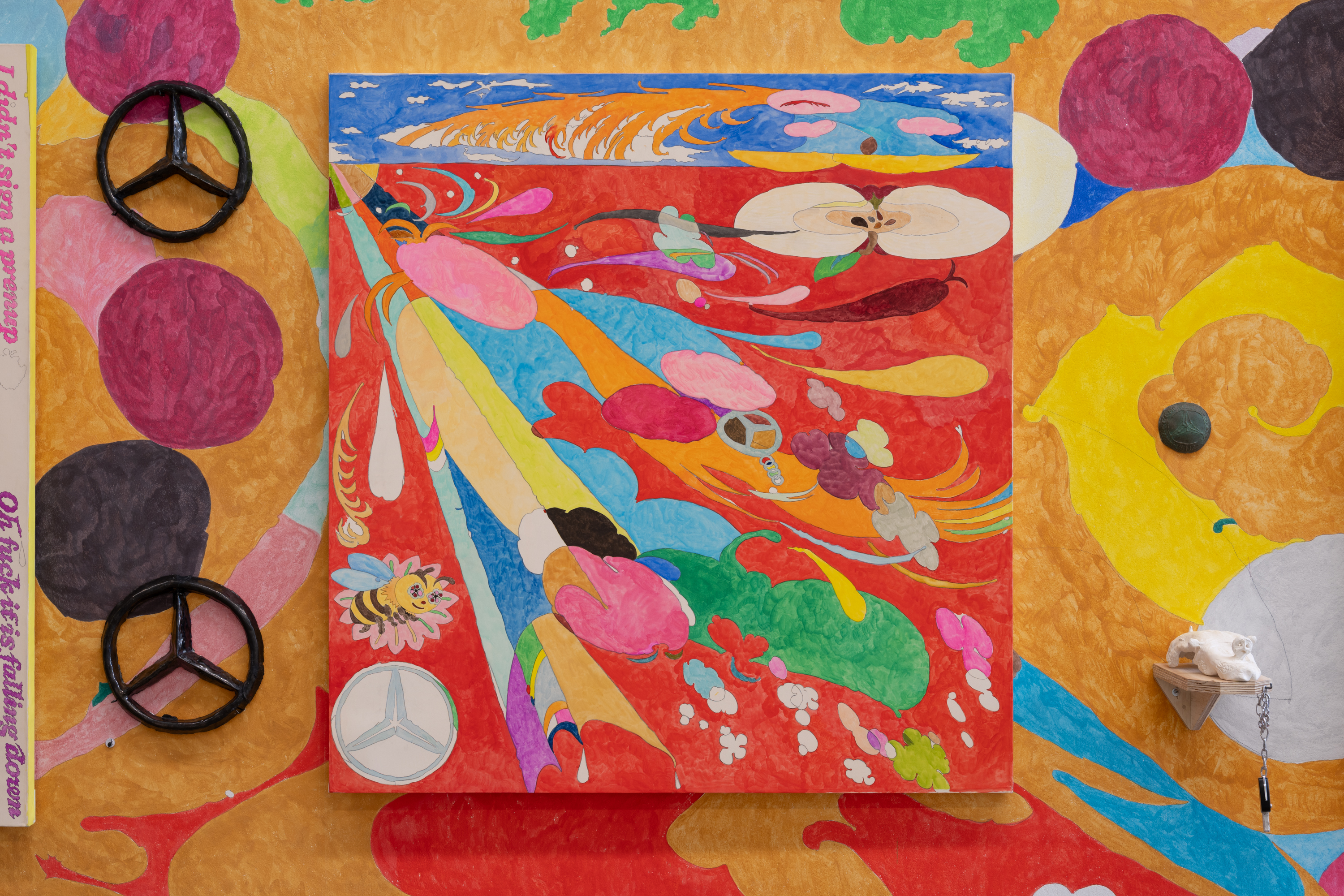
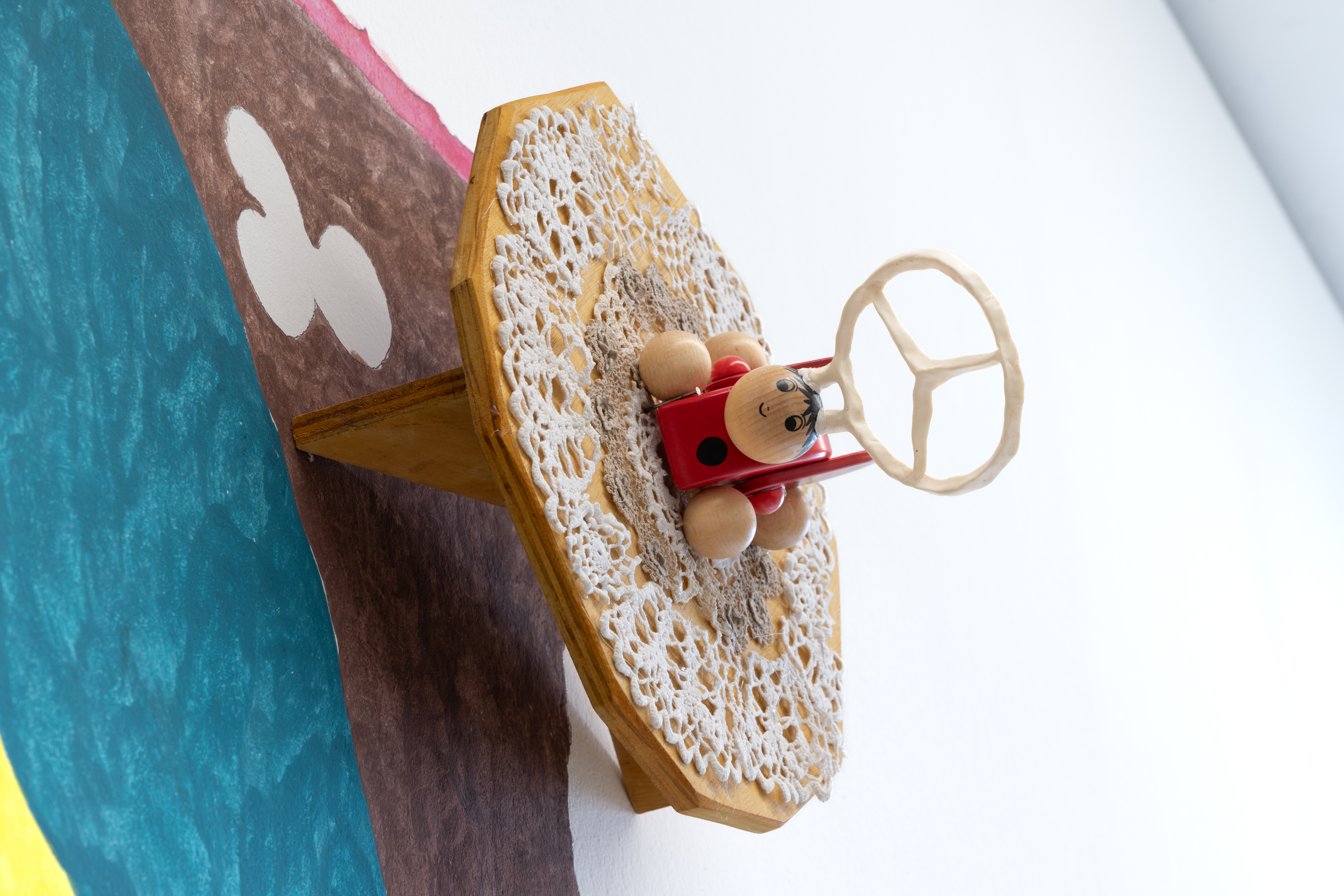
In Rondi Park’s (*Seoul, ROK) practice, lived experience functions less as fable than as ignition. Seemingly trivial incidents are stretched, refracted, and reassembled through drawing, painting, installation, textiles, sculpture and performance into systems of meaning that touch on myth, economy, and survival. Her work repeatedly returns to moments in which the personal collides with inherited narratives: like national origin stories or contemporary tales manufactured by corporations. Between these scales (ancient and hyper-modern) Park locates the artist as a precarious figure, navigating instability, responsibility, and the pressure to choose correctly when the stakes feel irrationally high.
Picture a summer evening’s walk by the Rhein : fading daylight, a bluish atmosphere, the last warmth of sun lingering on. Your hands feel light as you realise you dropped something over the edge. A car key, attached to a small trinket, begins its irreversible descent toward the dark water. What follows is not simply panic, but rupture. Sound becomes tactile; the scrape of metal against stone registers as friction felt through the back of your neck. Rational stutters (recognition, disbelief, dread) until it overloads and gives way to an odd calmness. In less than a second, an entire future appears at risk. The mind observes itself from a distance, as if reflected on the far side of glass, watching a day, a week, a month, a year, disintegrate. A moment governed by three urgent conditions: the object does not belong to you, it carries the weight of a luxury brand, and it is needed the following day. These facts transform a falling key into a potential disaster. The body understands that action is required.
Park treats this episode not as a confession, but as a sort of diagnostic. Why does risking one’s body for an object feel inevitable, even righteous? Why does impulsive immersion in cold water read as the correct response? The answer lies not in the key itself, but in what it unlocks: mobility, reliability, social standing, continuity of a carefully assembled life. The phrase “I’d rather die” exposes a logic in which convenience has become indistinguishable from survival. Phones, cars, food systems, global connectivity, are internalised as extensions of the self, masquerading as organs rather than choices.
In Park’s work, brands are structures that promise protection and identity while concealing their violence. We are encouraged to believe there is no alternative but to leap into their currents. The river is an emblem of this belief: a flow we enter because not entering feels like failure. To let go of control, to accept loss produces insecurity that is almost unbearable. Accountability is redirected away from systems and toward individual action : you jump, you try, you prove your loyalty to the life you are living.
The artist weaves this modern compulsion back into older mythologies. The panic of the moment feels archaic, as though echoing an ancestral trial. Generations of suffering culminating in a body plunging into water to retrieve a misplaced car key. Yet the gesture persists as meaningful because it aligns with narratives of bravery, intuition, and moral correctness. Wet clothes, a soaked phone, a body that tried – these become evidence of having chosen properly. Her contribution to Plattform26 asks not whether the leap into the river was successful, but why it felt unavoidable.
Diogo Pinto