

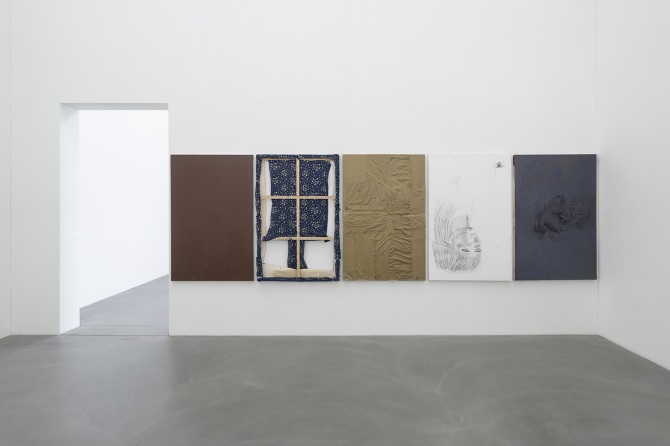
The Reader Interrogates Narrative, but Poetry Interrogates the Reader (1-5), 2022-2024
Anastasia Pavlou is a painter, a researcher, and a laborer all at once. Strongly connected with a notion of time and a reoccurring physical and mental effort, the artist paints and repaints, over and over again, takes canvases from the stretcher, just to turn them around before starting all over again. Objects are found, glued, and covered with massive strokes of paint. No color is anticipated, it would be like staging an accident. Between strong pictorial gestures, monochrome oil-paintings, the collage of found objects, and charcoal-drawings, ones that appear to be on the verge of disappearing, Pavlou’s practice reveals a multifaceted universe where categorizations are systematically rejected. At the core of the artist‘s practice lies the process, the unexpected, the risk.
While figurative moments and every-day objects alternate in the paintings, they all remain abstract to the artist. Her paintings do not aim to represent, rather they act as witnesses of an ongoing working process: a process that exploits questions about time, about materiality and about the physical gesture. The artist understands the act of painting as a search for a precise moment of harmony that enables a canvas to stand for itself, the precise moment for a painting to exit such a process, to be finished. Within an intrinsic working process, characterized by unpredictability and experimentation as well as a constant disruption and renegotiation, the artist formulates a personal guideline that is also a political one: we need to learn how to accept and be in an active relationship with abstract states.
The title The Reader Interrogates Narrative, but Poetry Interrogates the Reader (1-5) indicates an alternating questioning between the reader and written narratives, a logic that is closely tied to the artist’s general understanding of painting. Drawing on influences from poetry and literature, the artist finds new semantic meaning in the interplay of different paintings, just as the individual word finds new interpretation within a phrase. The five clinically aligned works in identical size suggest a chapter-like reading and, with a piece in the center, reference structures of a five-act abstract drama. It is therefore not only within these acts, but also between them, that Pavlou’s visual language unfolds. While the individual paintings act as a documentation of a specific moment in time, the act of bringing them together enables an additional comprehension of their external references and codependencies. Aligned, the paintings allow an understanding of each work‘s individual role and a conclusion of something that is partial to something new, as a whole. They ask about how we arrive at certain points. They ask how we understand what we see. They ask how we deal with the uncategorizable. Most and foremost, they ask us to search for it.
Marius Quiblier