

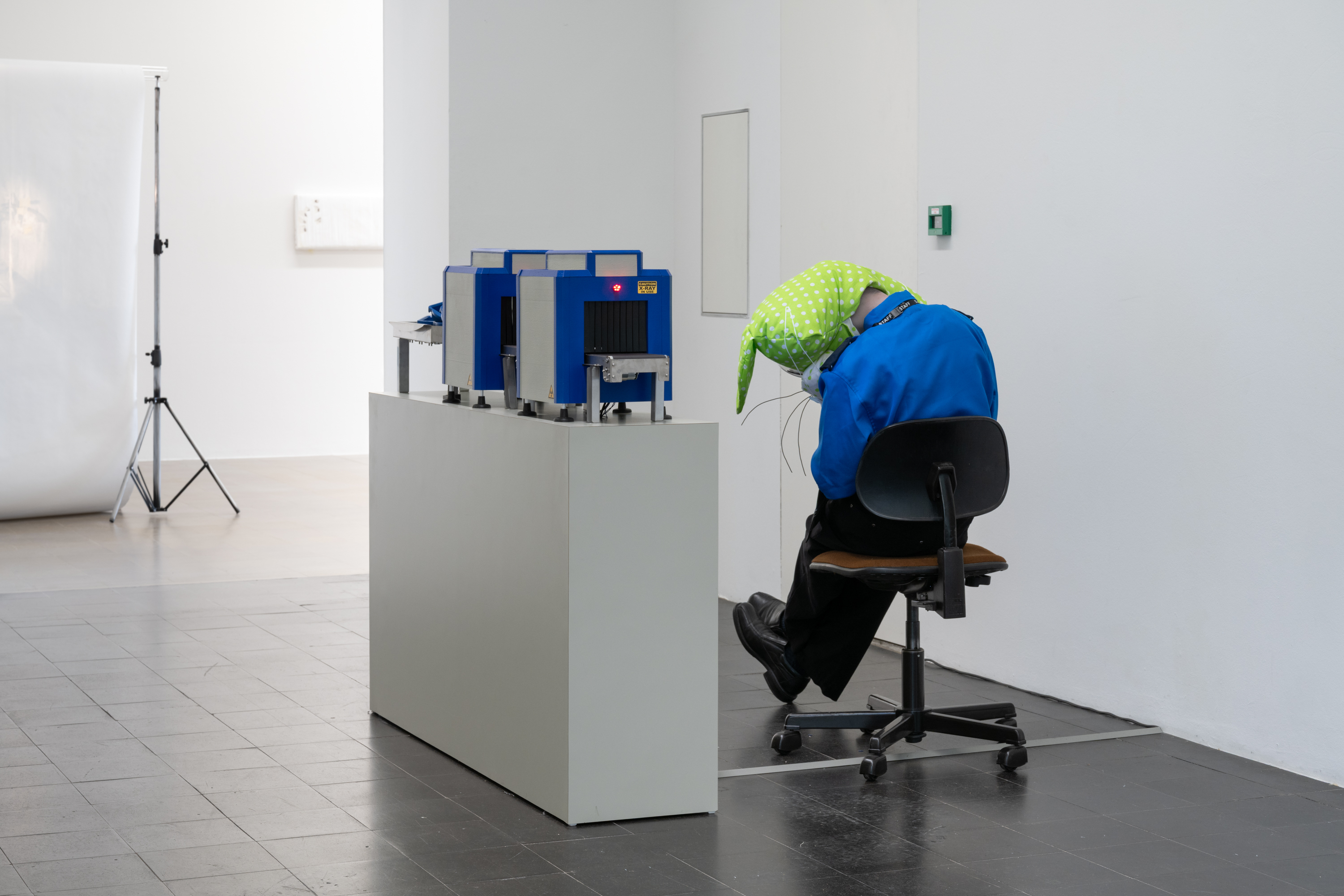
The first artwork encountered in the passage leading to the exhibition space was created by Paul Fritz & Melody Lu. Based in the canton of Vaud, the two artists pursue distinct individual practices, while simultaneously developing a collaborative body of work that combines sculptural installations and video. Together, they imagine fictional worlds populated by cartoon-like figures which, beneath a partly playful aesthetic, offer a sharp reflection on real socio-political situations. In their works, the absurd creates an offbeat atmosphere, revealing the potential of the imagination as a form of joyful resilience against defeatism.
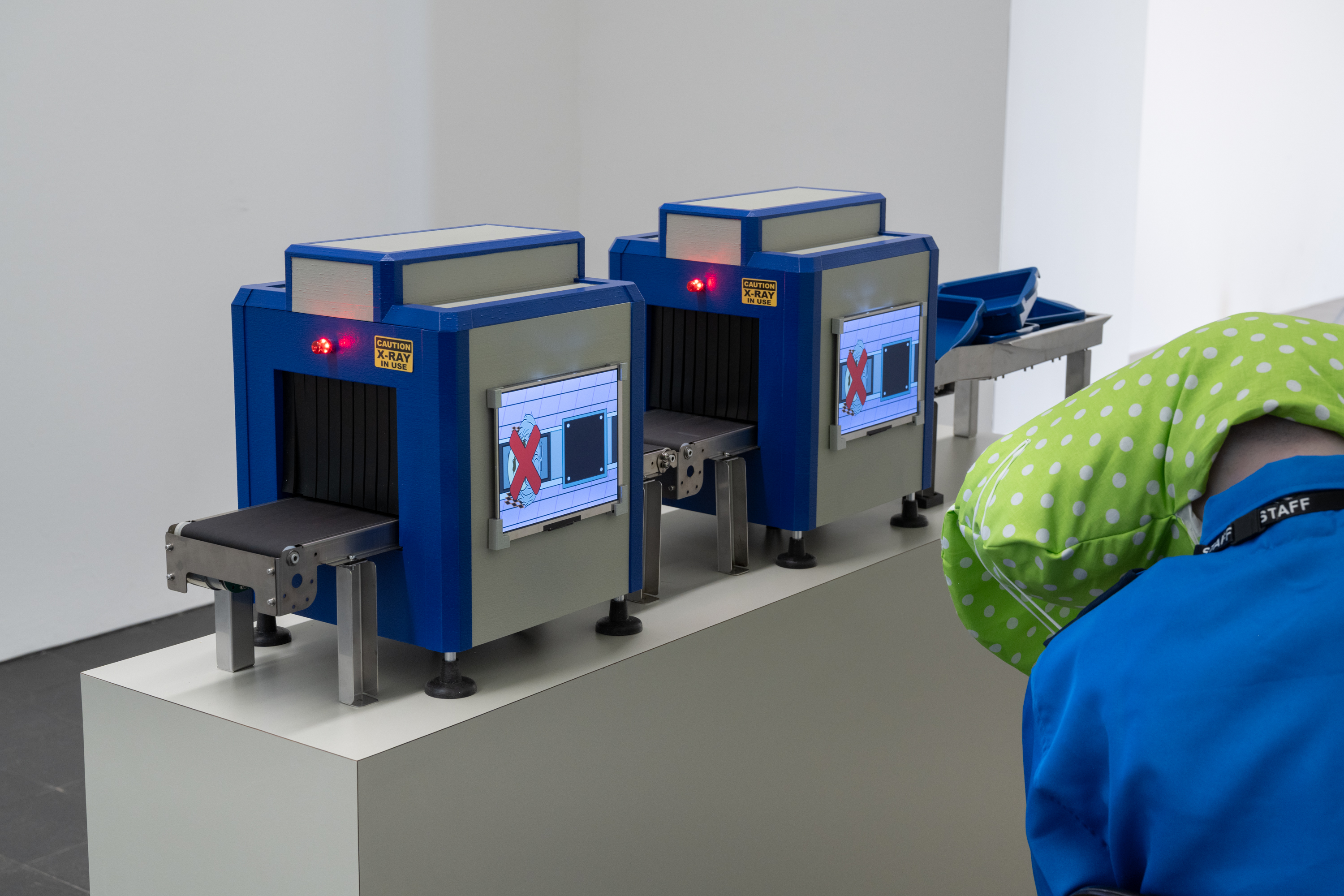
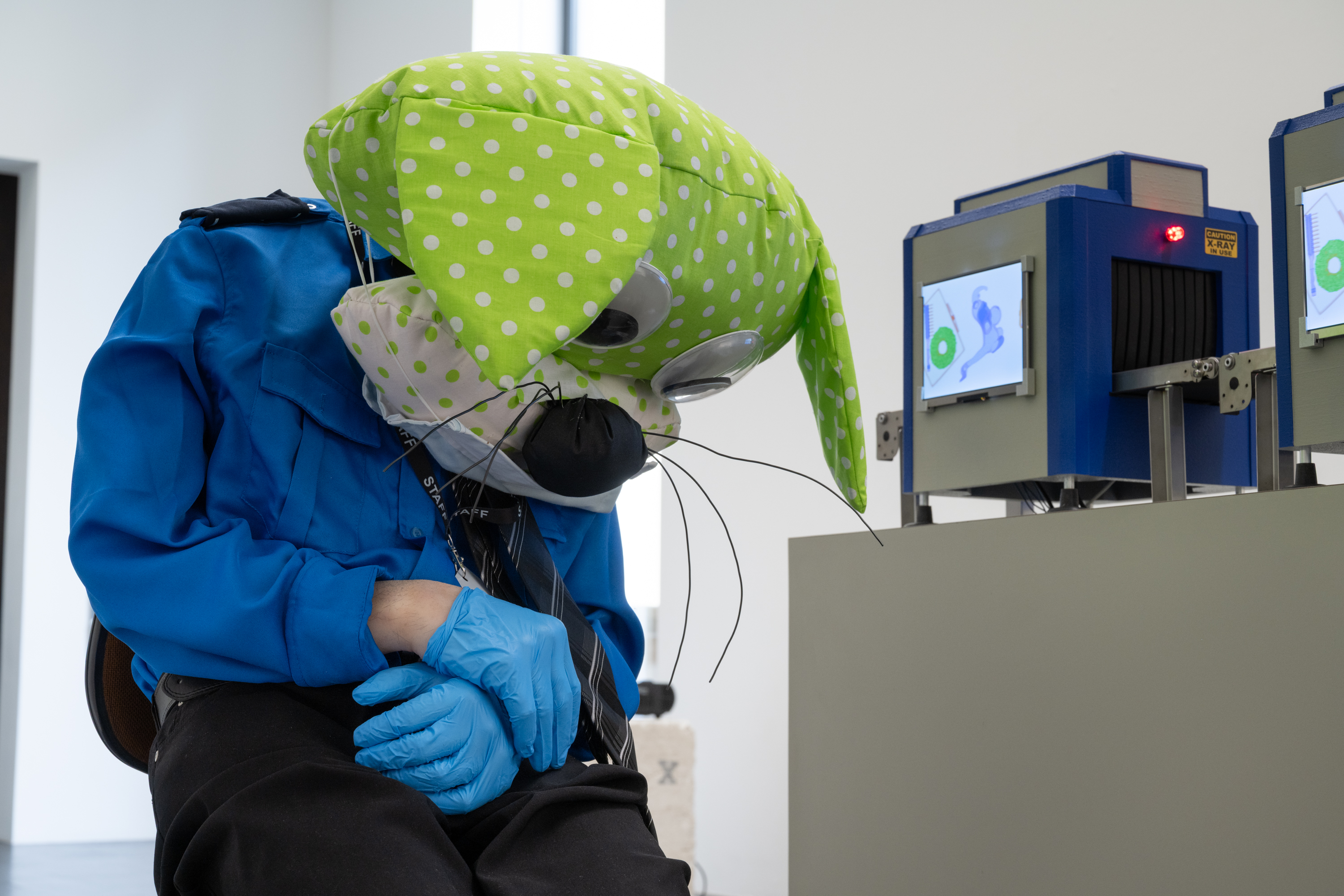
The work they show in Plattform26 constitutes the final chapter of a series started in 2024, forming what the artists refer to as their “end-of-the-world trilogy”. In it, the duo address a contemporary anxiety linked to the state of the world through hybrid installations where scales and narratives are blurred. For the context of Plattform26, Fritz and Lu turned their attention to the ritual of passing through a security checkpoint. Although familiar, the scene is marked by several incongruities: a guard with a mascot-like head appears to be dozing, the X-ray machines are miniature and raised on a pedestal, the accumulation of plastic trays at the end of the conveyor belts obstructs smooth circulation. On small screens, an orderly procession of whimsical objects and unexpected relics scrolls past. These suggest the presence of creatures who have deposited their belongings without fulfilling the civic duty of returning the trays to their proper place. In this world suspended between Looney Tunes and everyday lived experience, rational analysis seems futile and gives way to a series of questions: who are these figures passing through the scanner? What danger justifies such a device? And what is the value of such a control system if the agent has fallen asleep?
X-ray imagery belongs to a specific visual regime that the German author and filmmaker Harun Farocki described in 2004 as “operational images” (1). Produced by and for technical development – military, medical or industrial – these images exceed human perceptual capacities. From a “ghostly” perspective, they fulfil a precise function: to inform the power structures that generate them and to participate in the biopolitical project (2). Since 2001, surveillance technologies and X-ray imaging have gradually spread into public space in response to security imperatives, contributing to a norm of public performance that embraces transparency. This practice, which turns bodies inside out in the name of security, simultaneously determines who passes the test and who represents an opaque danger (3).
In their artwork, however, the machinery reveals an essential flaw: the overworked agent dozes off, rendering the control process absurd. This failure thus operates as a form of resistance to soft power at a time when security narratives, frequently nationalist, are used to legitimise acts of violence. By exposing the fragility of the system within a fictional atmosphere, Fritz and Lu highlight the fine line between security and abuse of power, and, while revealing the potential failure of systems in which we place blind trust, allow a glimmer of hope to emerge: the possibility of passing to the other side while escaping the gaze of
the machine.
Monica Unser
(Translated from French)
———