

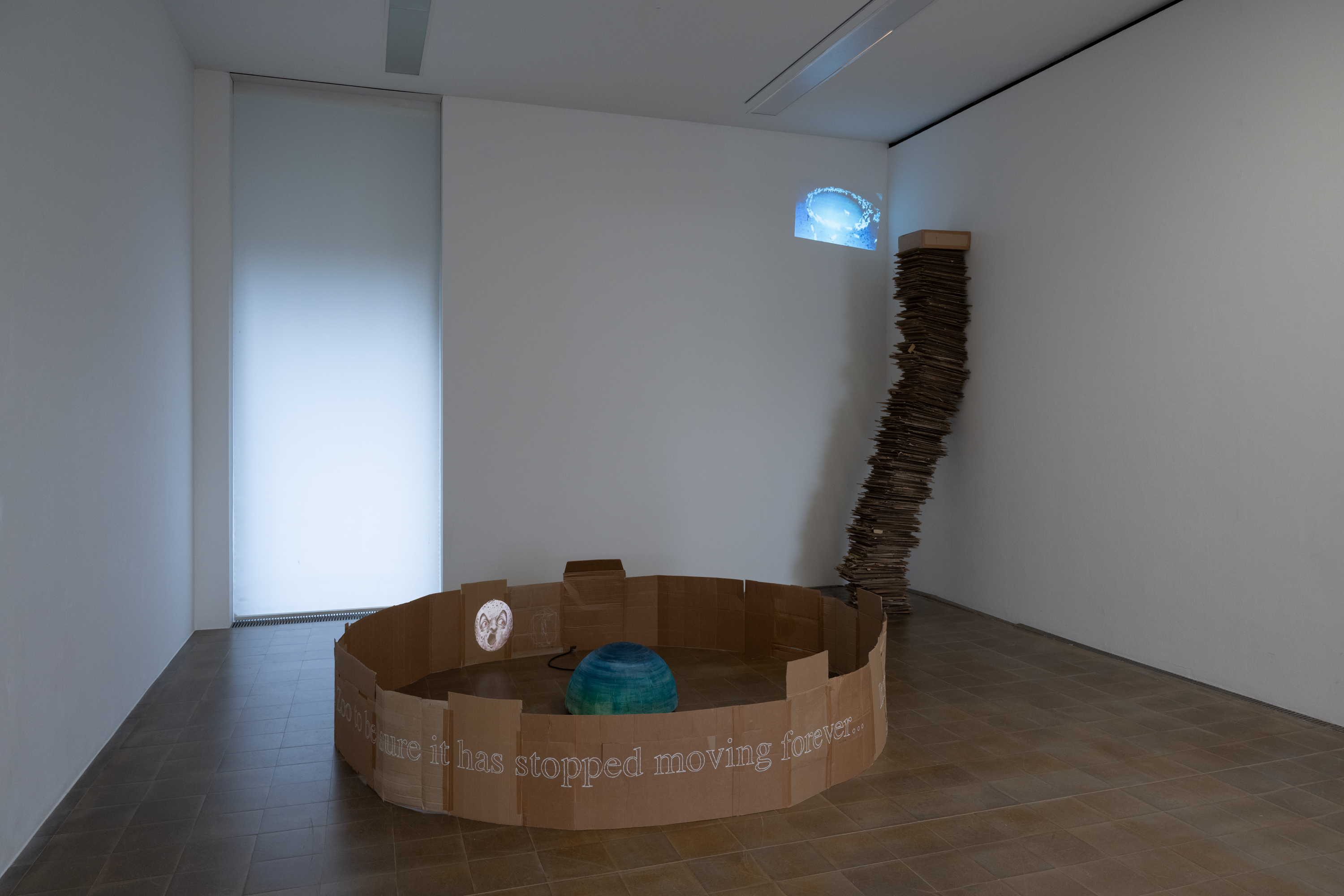
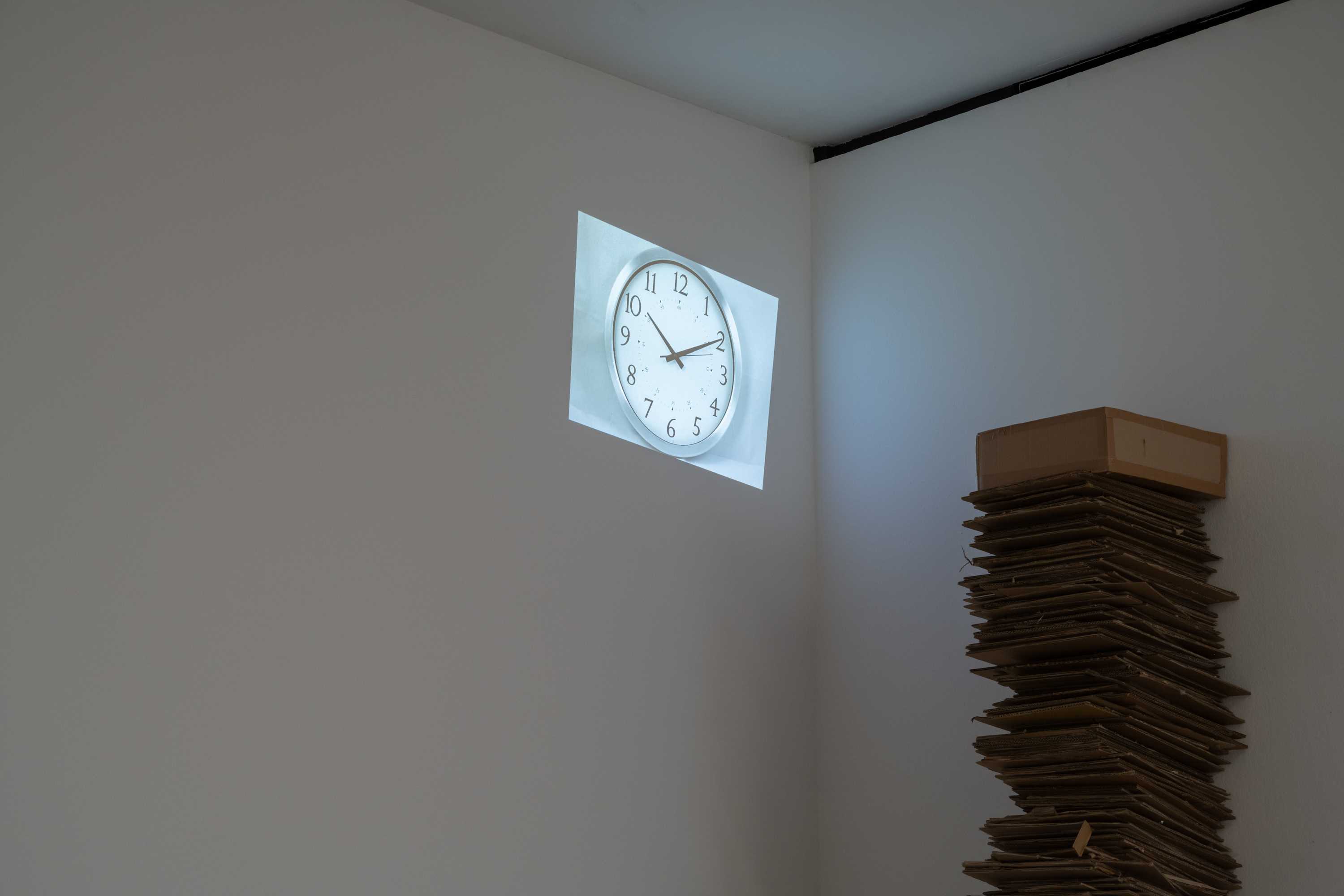
In a corner of the room lies the center of the world. Here, planet Earth finds itself right where humankind decided it belonged, in the middle of the universe. “But overnight, the universe lost its centre, and by morning it had countless ones” (1). Galileo confirms Copernicus’ bad news: the Earth isn’t the center of the world. Suddenly, in the 17th century, the celestial harmony advocated by the Church was shattered due to the discoveries of the humanists. Now, holding the keys to knowledge in their pockets, human beings place themselves at the centre of the universe.
The work of the duo Nearest Pond consists of two video installations in which the motifs of rotation and its centre reflects on the human tendency to position oneself as the central reference, assuming the universe revolves around one’s desires. A vicious circle, whose beginning is difficult to pinpoint but with an end that is drawing nearer, like a post-apocalyptic film played in fast forward.
Circular and spherical motifs have long served as a means for human beings to make sense of their environment. Engraved directly onto nature, they have been found all around the planet since the paleolithic era. These illustrations, named “cup marks”, consist of a hollow circle surrounded by rings, like an unintentional foreshadowing of the solar system. A form of anthropisation, marking human passage. Archeologist Christopher Tilley apprehends these images with the concept of rhythm in mind, of the rocks clashing sounds during carving, of the rituals associated with them, as well as the passing of the four seasons (2).
In Nearest Pond’s pieces, a crescendo rhythm prevails. In Where did all the blue skies go?, through a selection of video found footage assembled in sequence, humans,machines and animals come together in an ever-accelerating dance, the “Great Acceleration” described by philosopher Timothy Morton (3). Nature and culture sometimes struggle to share a home. Driven by the power they attributed to themselves, human beings rearrange the ecosystem’s rhythm as a selfish orchestra conductor. The passing of the four seasons doesn’t make any sense anymore.
Science, technology and the resulting feeling of powerfulness makes it seem as if everything can be calculated or inserted within a system. Such a case is illustrated in the Codex Huygens, an encyclopaedic work from the Renaissance, the source of the character pursued by Méliès’ Moon in Nearest Pond’s video titled Still Standing(?). While the chase between the moon and the individual accelerates, the text covering the cardboard wall evokes a completely different pace, a kind of slowness, which compels the audience to reverse the direction of their steps in order to make sense of the sentence.
“It moved at a rate of less than 2 feet a year so it took a while for the curators at London Zoo to be sure it has stopped moving forever…”
A threat looms over London Zoo. While it remains challenging to determine exactly what is about to happen, the message is crystal clear: the end is near, or has already begun. The three dots at the end of the text raise doubts and remind us that nothing is set in stone yet. “The end of the world is not a sudden punctuation point, but rather it is a matter of deep time” (4). Any minute now, the pile of cardboard will collapse, and so will we.
A pile of cardboard boxes, maybe the end of a move or the prelude to a great departure. A slow departure, at the pace of an endangered snail, but a constant, inevitable process.
Flavia Vuagniaux
(Translated from French)
———