

What is the common denominator between a car, a dinosaur, masculinity and the book Capitalism and Freedom?
The practice of Lourenço Soares is a practice of research by the means of art. A research on the syntax, forms and ecologies of knowledge. It is a work of de/monstration and his projects often borrow from the so-called hard sciences a methodology of models analysis.
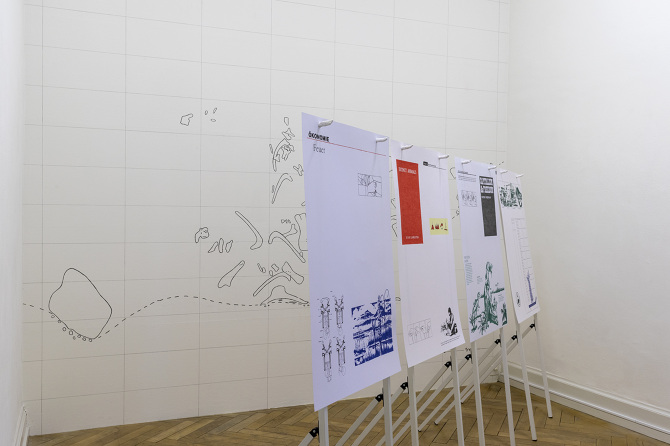
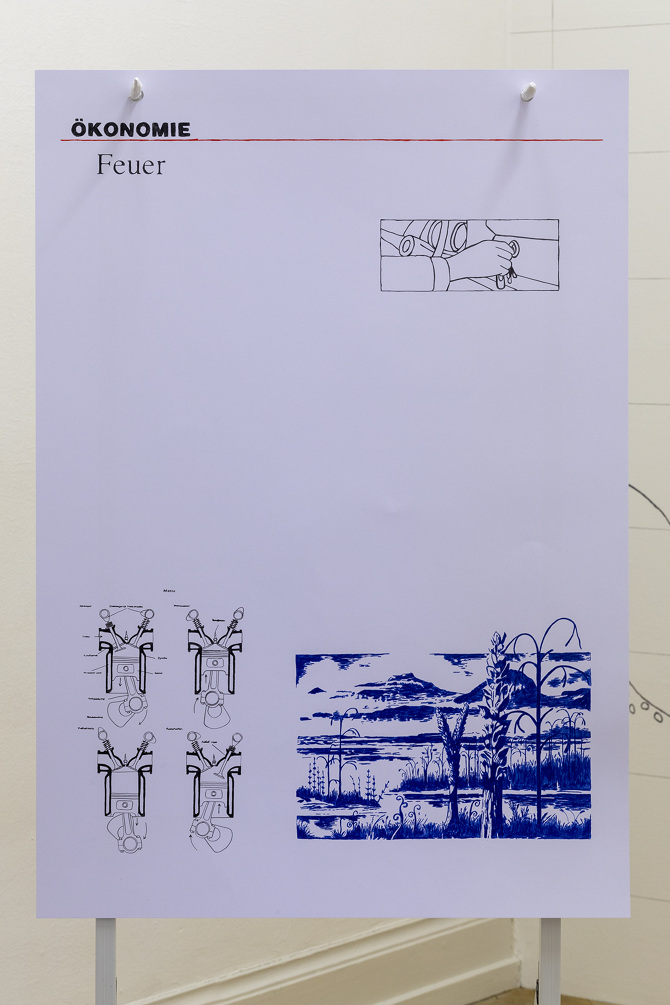
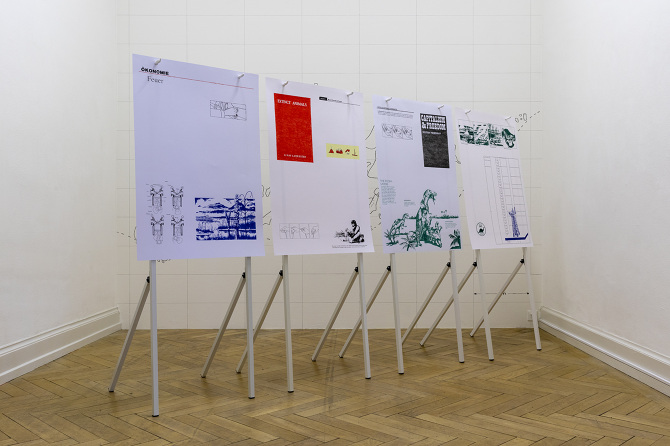
For Plattform22, Lourenço Soares presents an installation composed of a mural and four iconological panels, composed of hand-drawn images taken from scientific or educational publications. It is an exercise in montage and analogy, whose methodology is similar to that developed by Aby Warburg with the Atlas Mnemosyne, an attempt to read the present by freeing itself from the categories and grids of reading imposed by traditional historiography. The panels oppose, on the one hand, the visual paradigm of the representation of a history that has become canonical through the image itself, and on the other hand, the epistemological paradigm of knowledge, in other words, a form of knowledge that tends towards immutable ideas and concepts.
Clearly in line with critical theories, the work participates in subverting the integrity of images that persist as dominant and defining principles of an era. By reconstructing history through analogy, Soares proposes a new way of reading the world in the present.
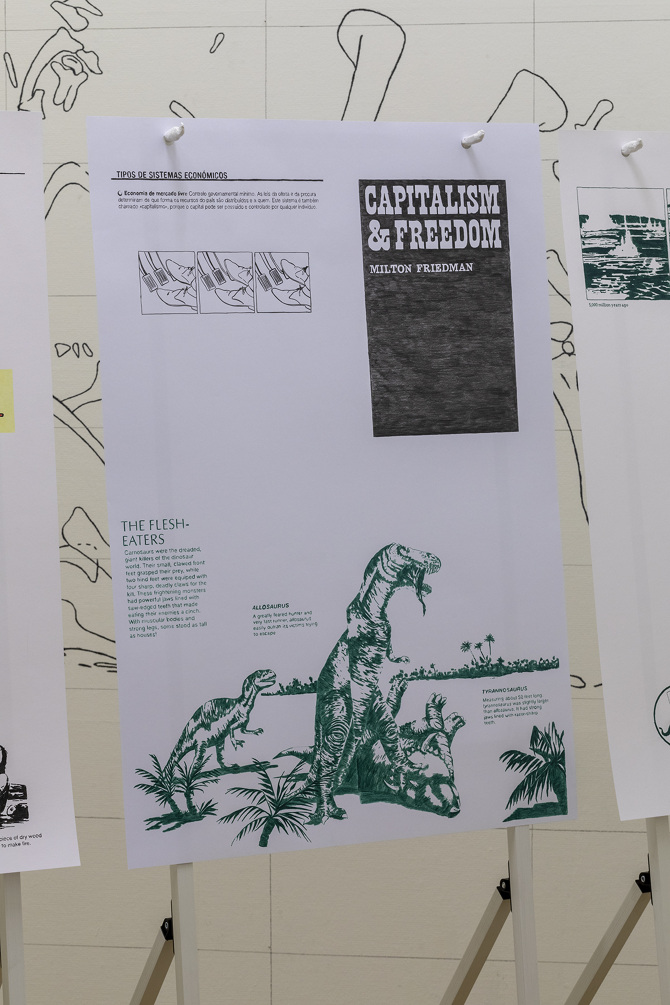
In Flipcharts (cars, dinosaurs, free markets), Soares opposes a chronological, territorial and disciplinary reading of contemporary history, which periodizes and categorizes facts without porosity. By allowing himself a broadening of the constitutive elements of history and the creation of a genealogy between characters and places having no link a priori, he thwarts the biases of an essentializing and standardizing reading, to propose a fluid understanding of the social phenomenon that is the advent of neoliberalism.
To answer the initial question, Lourenço Soares associates the phenomena of mass extinction to a mass of consumers unconscious of acting in the interest of a mass capitalism without perspective of extinction. Mobilizing a phrase attributed to Marx, the artist depicts capitalism as a monster with an insatiable appetite, extracting energy from everything it touches. His Tyrannosaurus Rex – King of the Tyrant Lizards – thus resonates with this monster-capital and is associated with the Consumer-King of the "free world" defended by Friedman.
Julie Marmet
Photo credits: Guadalupe Ruiz