

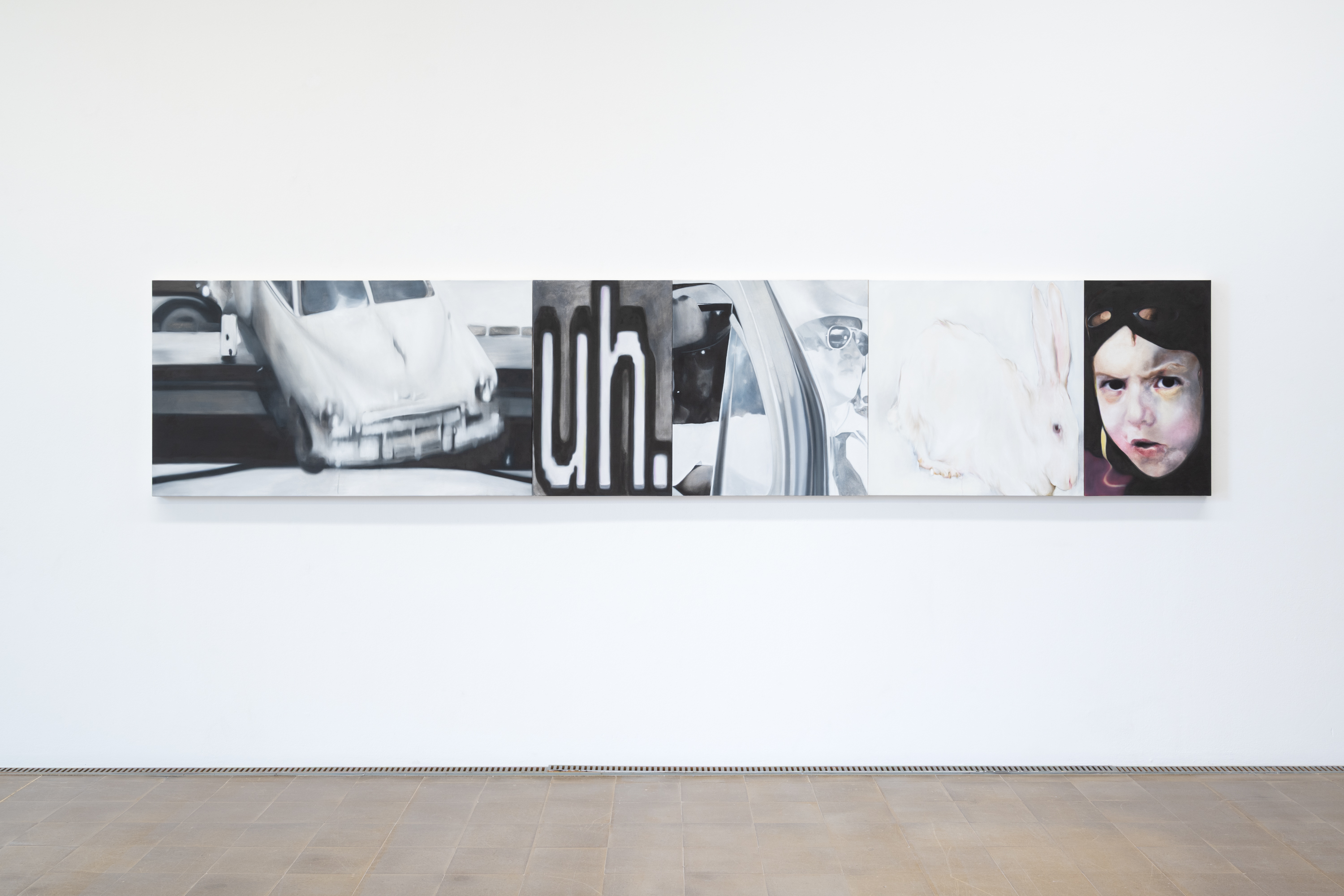
Artist’s Letterboxd profiles should be more of a thing! Julie Richard’s handle is “julierichlang”. As of writing there are 2051 films listed as watched and her current top four are Phantom of the Paradise, 8½, The Passenger and The Wild Bunch. It feels like a good place to begin... [CAR CRASHES OFF BRIDGE].
Julie Richard has forever been watching films on scratched iPods, on phones with dirty screens, portable DVD players (underrated device imo) and unreliable streams. This compromised way of watching was never about nostalgia, or rejecting high res, but pleasure and now method. Her paintings begin with images already altered by choice: blur, pixels, coloured glare, fingerprints, bad focus, distortion. Paused and rephotographed frames from films sit alongside photographs from her personal family archive as images that have already been through time, technology and memory before ever reaching the canvas.
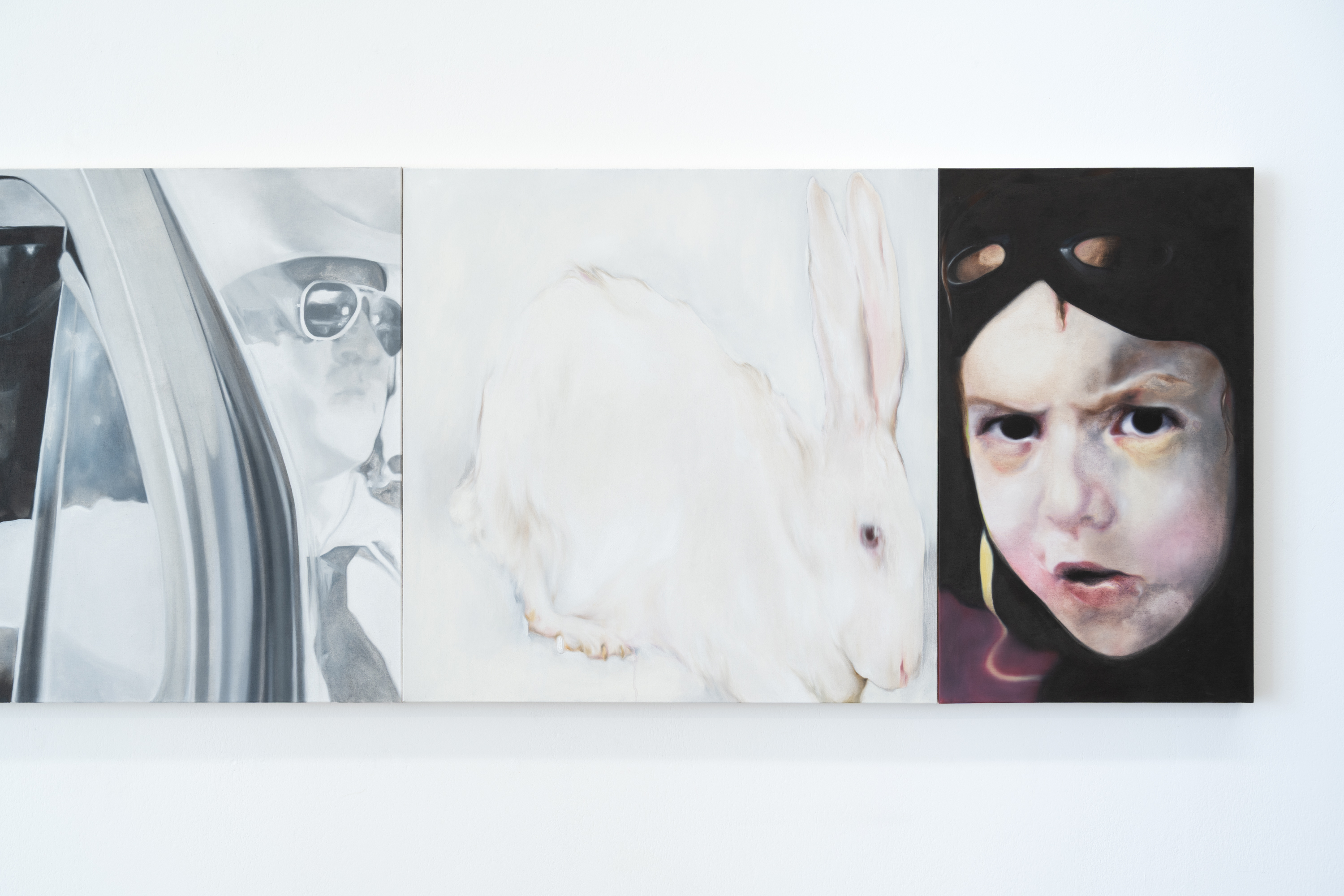
Painting is Julie Richard’s medium and the site where these images are slowed down, tested and materially reworked. Five paintings titled Uh. (2025- 26) hang in a single continuous line. All share the same height, while their widths vary, tightly pressed together. This spatial arrangement translates principles of film editing and montage into painting. Editing and montage here is not understood as a stylistic reference but as a structural theory. Meaning emerges through sequence rather than within any individual image: A crashing vehicle drifts out of focus as a cropped subtitle meets a zoomed in car scene (is that Clint Eastwood in the back seat?). A slightly distorted rabbit from the artist’s childhood, keen not to be caught on camera, follows and ends with an unmasked portrait of the artist’s sibling. Some transitions appear almost logical, others remain resistant. In this sense, the act of looking becomes a form of editing.
The strength of the work lies not only in its concept but in the quality of its painting. Blur, vibration and movement are built patiently through gesture rather than effect. Thin, wiped passages sit beside thick accumulations of oil paint, creating shifts in focus that feel bodily rather than optical. What appears digital is often nothing more than a brushstroke insisting on its own material presence. Julie Richard allows the translation from digital to analogue to remain ambiguous. Is this smear from the source image or the act of painting? The distinction is intentionally unclear, because in the end it’s about the painting.
Cinema, for Julie Richard, is the most haunted of arts. Many of the figures she paints belong to a world that no longer exists, and to lives that have since passed. Stripped from their narratives and repainted, they become ghostly presences. Placed alongside intimate family images all distinctions between the collectively known and private memory collapse. Back on Letterboxd, my watchlist keeps growing as I scroll through films filled with scenes that stay with me, the space between images doing most of the work.
Jack Pryce