

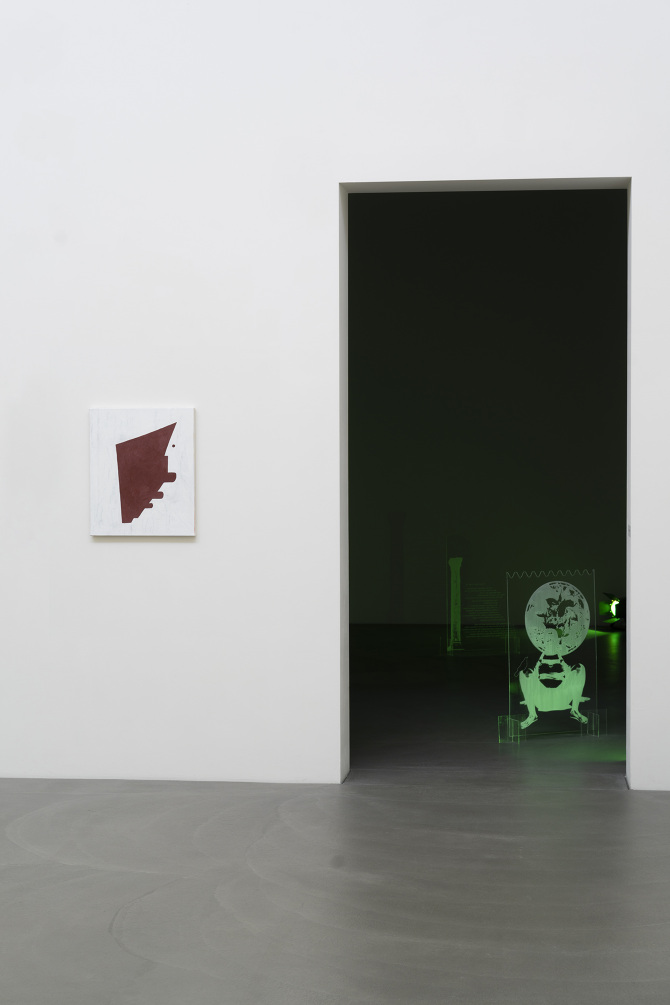
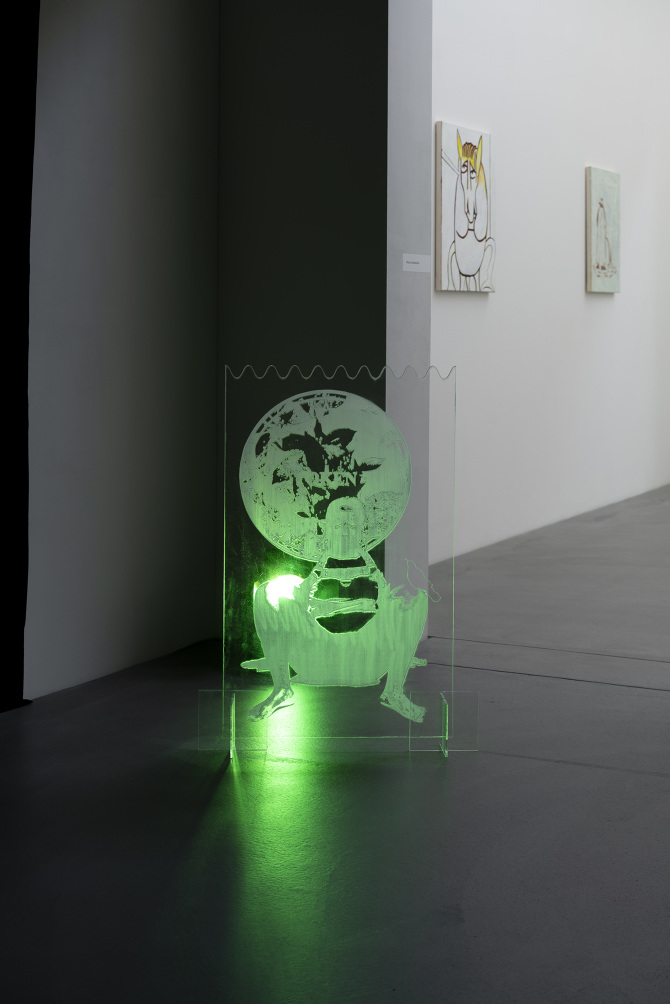
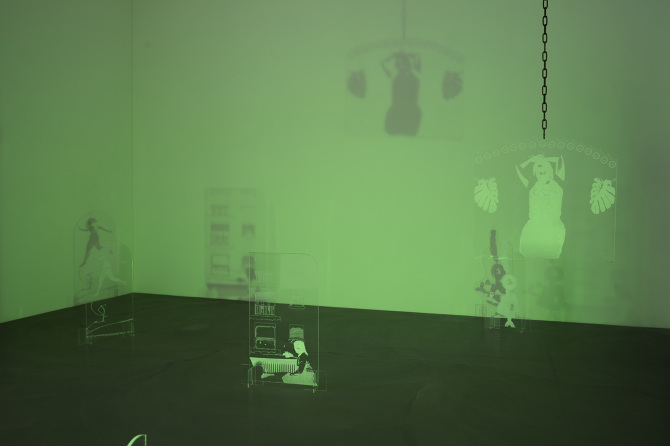
Désir d‘opacité, 2024
The outlines of the projections emanating from Gemma Ushengewe‘s expansive installation Désir d‘opacité (en. desire for opacity) are intentionally partially blurred. The textual passages and figurative representations delineated on the walls of the exhibition space evade the control of a rigid and normative gaze, altering their contours and manifestations depending on the incidence of light. The contrasting shadows address Gemma Ushengewe‘s personal relationship with identity discourses prevalent in majority society. They reflect the need to liberate oneself from the policies of capitalizing on identities, which produce categorizations and reductions – also known as tokenization. Gemma Ushengewe seeks, through the own artistic practice, potential escape routes from the norm towards a new approach to social and political hierarchies as well as the complexity of one‘s identity. –What seems to be at stake here is the development of a personal aesthetic of resistance.
Both the concept of transparency and that of opacity are significant for the work Désir d‘opacité. As Édouard Glissant notes in his Discours Antillais 13 (1981), transparency is one of the fundamental conditions of majority society: It allows hegemonic cultures to understand and accept, but at the same time serves as a ground to compare, evaluate, exoticize, and surveil the Other. In the expansive installation, Gemma Ushengewe refuses to employ the codes of the dominant and thus juxtaposes the opacity of shadows against the transparency of plexiglass. Against this backdrop and bathed in an almost menacing green light, the opaque becomes something that is not entirely graspable and therefore not reducible. The opaque becomes recognizable as a vibrant attitude, providing space and agency for the multifaceted and complex facets of an ever-changing identity and ultimately calling for new relationships between subjects.
Selma Meuli (translated from German, P24)