


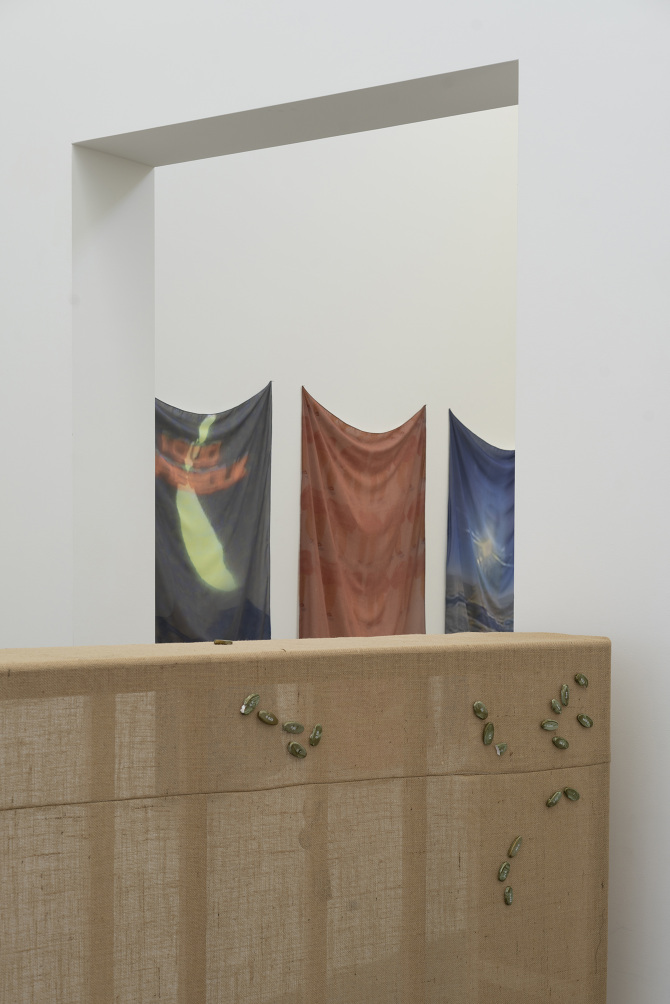

Resurrection Ranch, 2024
The prefix in "resurrection" suggests a cyclical dynamic of repetition.
There are certain things and ideas that – morally and ethically speaking – should not be brought back to life.
Gregory Whitehead’s object of interest or analysis of the fictitious 2012 documentary of the same name is a so-called resurrection ranch… a luxury service business where burned out corporate execs and political honchos are promised resurrection or learn how to get back into the saddle.* The wonder and astonishment upon our cowboys’ resurrection present and past might steal anyone’s spotlight. Virginie’s Resurrection Ranch, however, takes a different turn to point at blind spots instead – resurrection… sure… but resurrection at whose costs?
While Whitehead’s resurrection ranch might capitalize on the cowboy’s failure, the horse fly remains a bloodsucking vampire. It’s a symbiosis slightly off-balance or a parasitic relationship suggested by nature: The female fly feeds off your horses’ blood to be able to reproduce – it might transmit diseases but it’s more likely for your horse to experience hoof damage and lameness from excessive stomping upon annoyance. This is especially damaging for business, since… well… lame horses are as useless as a knife without a blade. Horseflies are abundant as well as persistent but lucky us, most horsepower was replaced by more autonomous and hygienic machines in the course of technological progress. A slight shift in industries and body parts – today, the economy’s interest lies less on horses’ strength, legs or hooves for that matter, than their reproductive organs and biopolitical juices. Even though we should know better, it remains an eerie encounter to meet the blood farm industry that extracts various hormones from mares in forced perpetual gestation for interspecific consumption and economic profit, of which the mare’s suffering is merely collateral.**
When a fly or a mosquito lays eyes on me, I try to stay calm at first, gently but pointedly brushing the aimed at body part. But there usually comes a point where things turn personal – I will chase them around the house until left disoriented by my own hovering and the insect’s perpetual refusal to surrender – they must be taking the piss out of me, what a blunt interruption of capitalism’s exploitation of my labor.
It’s a different kind of displacement we experience when entering Virginie’s Resurrection Ranch. It might be spatial, as the viewer’s movement is governed by sculptures dividing the room in two; or positional, as we will never conceive of the full picture at once even if we manage to peek beyond the walls; or theatrical, as we encounter a piece whose stunts are caught in a continuous cycle of self-debunking; or conceptual, as the metaphorical conflation of horse fly and pharmaco-industrial product might blur the distinction between artificial and natural extraction; or it might even be ethical, as the horrors of Virginie’s research seem wholly intangible but her delivery so utterly burlesque.
It is as if she would suggest: Let us resurrect the mares – not as in saddled-up bronze and heroic timelessness but as fragile jute in subversion of the exploited body instead.
Welcome to the ranch.
Antonia Rebekka Truninger
**Donna Haraway, “Awash in Urine: DES and Premarin in Multispecies Responsibility,” Women’s Studies Quarterly 40, no. ½ (2012): 301-316. Until a few years ago, the extraction of Equine genadotropin (ecG) (a hormone used for pig, sheep, cattle and goat breeding to generate suberovulations) from mares’ blood was a method widely employed in order to control the fertility periods of farm animals for uninterrupted meat or milk production. Another example entails the estrogen Premarin, which is gained from the urine of mares which undergo repeated pregnancies to uphold hormone production. Premarin was widely administered in the United States from the 1940s until the 200s to people suffering from menopausal symptoms.