

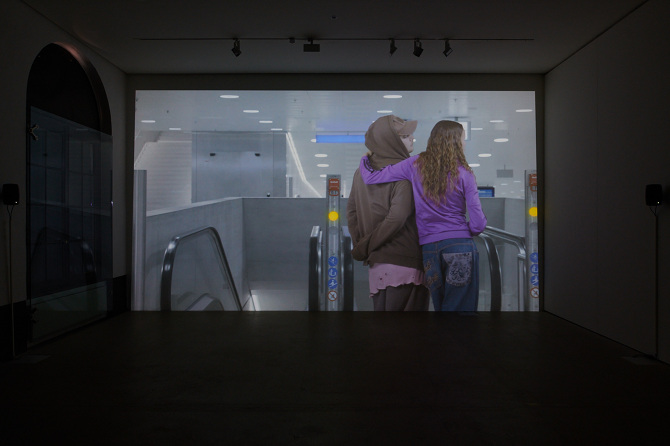
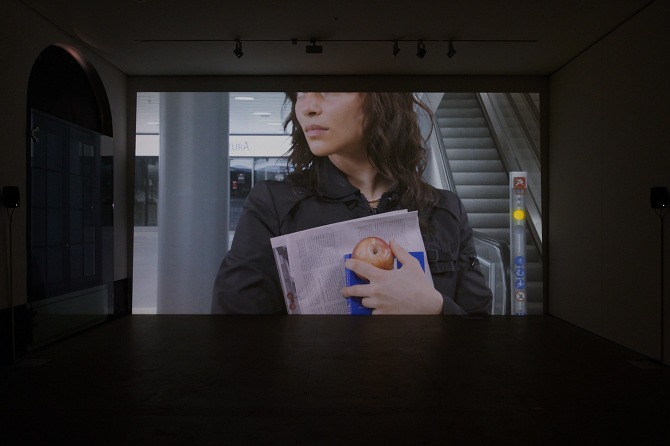
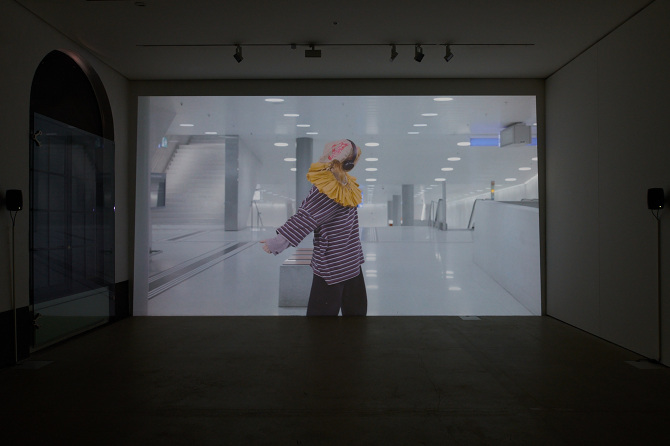
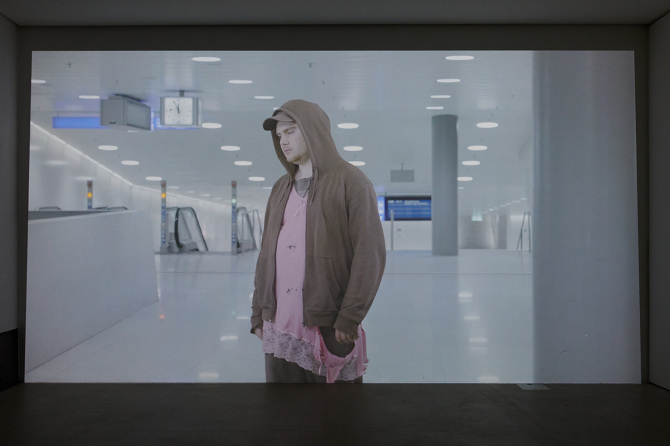
moving places or about the scaled subject, 2023
Raffaela Boss' work moves up close to bodies, through the body.
Raffaela is interested in bodies that walk, stand, hold hands, raise their heads and lower their eyes, stretch out their arms, turn on their own axis, spread their toes or put one foot in front of the other – for their bodies’ movements that become constricting patterns through daily repetition, or for unexpected movements that contradict a normative narrative.
With moving places or about the scaled subject, Raffaela presents an ambivalent image of bodies in motion. It introduces eleven people situated in a passageway of Zurich's main station. How do we behave in public places such as these? Like Julian, who is practising a piece with his headphones on? He sings loudly. Too loud? Or like Charlotte, who is humming absorbedly as she looks past the camera? We observe a collaged juxtaposition between a metonymic space of the public and shots of subtle movements suggesting moments of intimate privacy. Raffaela involves us in an alternating game of proximity and distance, also expressed through sound, when the rolling of the escalator seems as foreground as the smacking of a kiss.
Raffaela's camera moves slowly, almost ghostly creeping past the various scenarios without ever halting. Its supposed, almost exaggerated apathy – the cinematography appears somewhat documentary-like – brings into focus the perspective of the camera filming the performer or the gaze to which she is exposed. Who is Priska looking at when she directs her gaze directly into the camera? The filmmaker? An omnipresent audience? Me? In the double role of artist and performer, Raffaela undermines the linearity of the relationship between camera and performer. She approaches the subjects with a cautious gaze that does not expose them but rather is meant to be understood as an invitation to share something with her or us.
Nevertheless, there remains lingering doubt: For details in montage and editing expose initial assumptions of an endless loop or one-shot scene as misguided. With imitations bordering on deception, but always already identified as such, Raffaela also questions strategies of narration and image production per se.
Raffaela Boss invites ten people – some close friends, others only fleeting encounters – to participate in moving places or about the scaled subject. In her studio in Basel, Raffaela films the performers in front of a green screen. They are asked to wear their everyday clothes and move in front of the camera in the way they feel most comfortable. There are no further instructions for action.
Antonia Rebekka Truninger
Performers: Charlotte Horn, Sven Gex, Emma Müller-Morungen, Olaf Tavares, Julian Elias Bächtold, Priska Morger, Susi Hinz, Marcus Karkhof, Hans Peter Marti, Yann Slattery, Raffaela Boss
Camera: Linus Weber; Sound and sound design: Jonas Huldi; Support for post production: Linus Weber, Martina Jung; Assistance: Azur Sabic
Supported by Abteilung Kultur Basel-Stadt
Photo credits: Margot Sparkes