

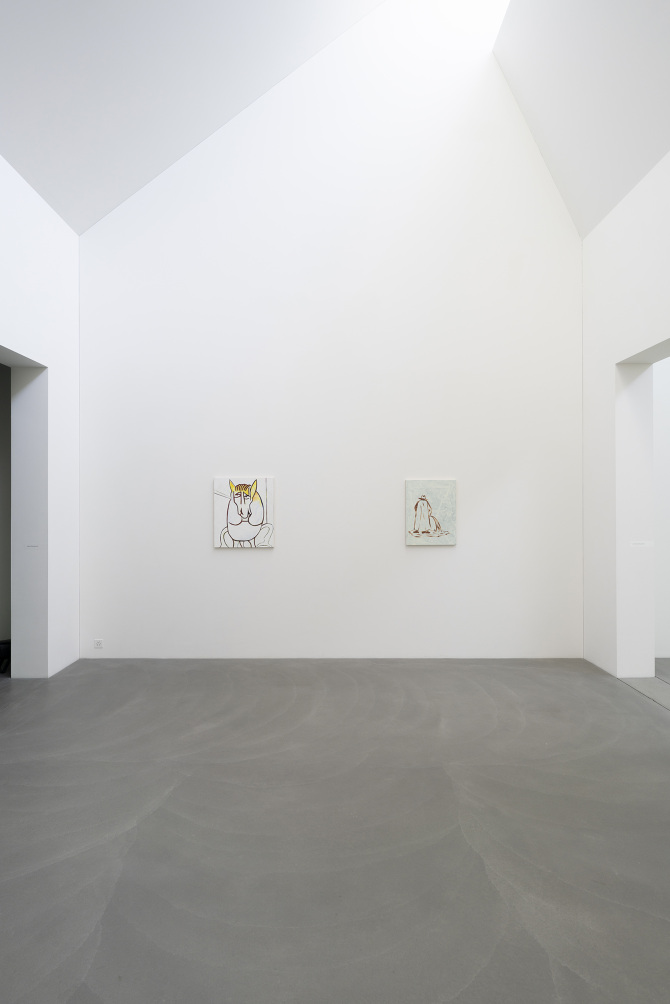
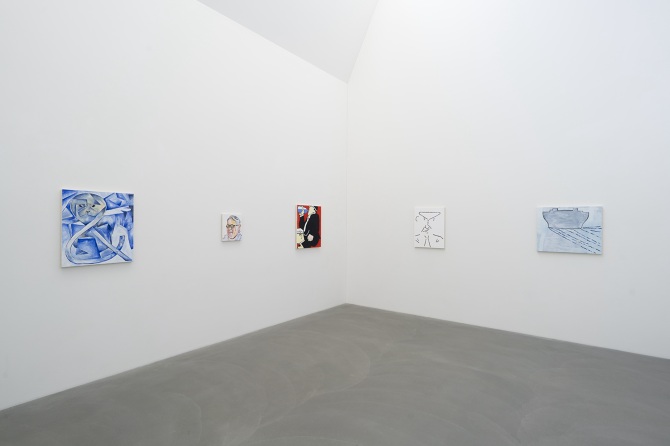
Never change a winning horse, 2023
Zu neuen Ufern, 2024
Im Eis, 2024
Gut ist besser, besser ist gut, 2024
Herr Puntila und sein Knecht Matti (Nach Heinz Jost), 2024
Hangers (Portrait), 2024
Einer fur alle, alle für einen, 2023
Rodent Invader, 2024
Schiff (Senkrecht), 2024
Between facial expressions that are difficult to read, gestural details and overpaintings still hinting at the previous moment, Mimmo Haraditiohadi‘s works combine drawn components with uncompromisingly painted surfaces. In a tale-like manner, coat hangers resemble noses, and ships become faces: The artist speaks of pareidolia, a phenomenon describing the moment in which a spectator recognizes faces and familiar objects in patterns and things. However, between all the hidden associations and references in Haraditiohadi’s work, no brushstroke seems to be incidental. At the core of his practice lies a questioning of the means of representation, symbolics and language.
The continuous merging of the letters "e" and "t" in late antiquity led to the development of the now well-known ligature of the sign "&". Due to its frequent use in business language, the Et-sign (Latin et) is often used synonymously as what is called "kaufmännisches Und" in German (in a word for word manner "corporate and"). While the symbol is usually used in concise company names, in Im Eis, it is home to the body of a seal in an icy winter landscape. At the same time, Herr Puntila und sein Knecht Matti (Nach Heinz Jost) shows a much flatter way of painting, narrating the story of a drunkard whose formation of opinion changes when intoxicated. It is a reference to a poster by the Swiss graphic artist Heinz Jost for a play by Bertold Brecht at the Bern City Theatre.
Relationships between the individual works in the rooms of the Kunstmuseum Appenzell are enforced by a rotation of gazes. The critical smile of Haraditiohadi‘s father in Gut ist besser, besser ist gut, for example, is juxtaposed with the frontal gaze of a horse (Never change a winning horse) which is suffering defeat in a chivalrous duel. The tip of a lance, which seems to hit the horse from the side, serves as an indication of the external threat. In the midst of these events, a sleepy rat seems to be perplexed by the situation at hand.
Repetitions and cross-references are recurring elements in Haraditiohadi‘s painting. The subject of a cruise ship can be found in several paintings. For Haraditiohadi, it is an ambiguous symbol of departure and movement, which he confronts with mixed feelings. At the same time, the boats, which Haraditiohadi often uses as overpaintings for discarded pictures, also allow him to make a fresh start in his own works, whereby the underlying story never seems to be completely covered up. With playful ease, the painter relativizes the freighter‘s gravity in Schiff (Senkrecht) and changes its course. While the vertical waves suggest a marble surface, the red moon takes on the role of an eye, the ship becomes a window, its contours a face.
Haraditiohadi‘s style of painting is playful and complex at the same time. What we seem to understand at first glance is being put into perspective at the same time. Subjects are repeated, they reference each other while referring to narratives from different times and familiar symbols. The result is a multilayered visual language in which the artist illustrates the ambiguity of things, questioning the overall generality of individual judgment.
Marius Quiblier