

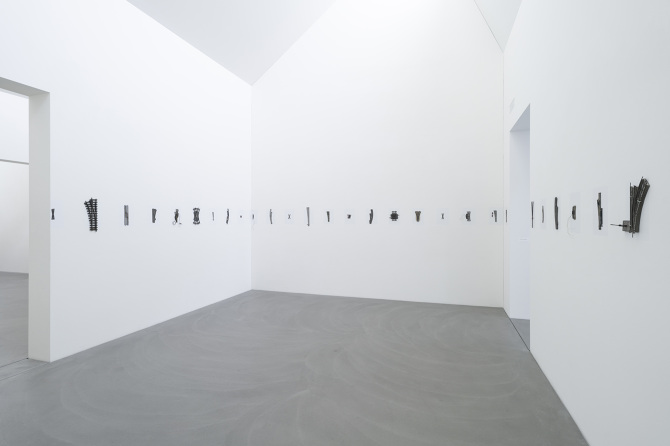
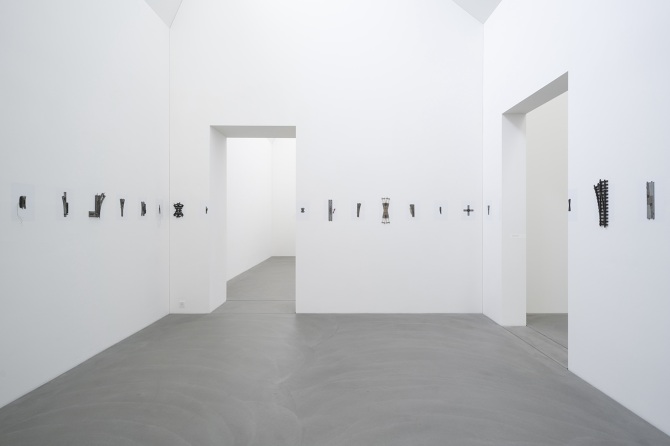
strata of (latent) practices, 2024
Railways are physical manifestations of rules that we take for granted, essential to the movement of people and goods. The foundations of these railway tracks are universal: their function is based not on a subjective conception, but on objective physical laws. The ultra-precision required to design railway systems, and hence the ultra-precision required to design model railway systems, stands in stark contrast to the arbitrariness of a human life.
Leevi Toija most often uses moving images and the context/exhibition space to make the underlying structures of society intelligible, dissecting what is considered to be objective and/or universal. Toija analyzes the systems that shape our actions and, by extension, our thoughts (or vice versa?): he draws attention to the syntax of our movements and prompts reflection through subtle semantic shifts.
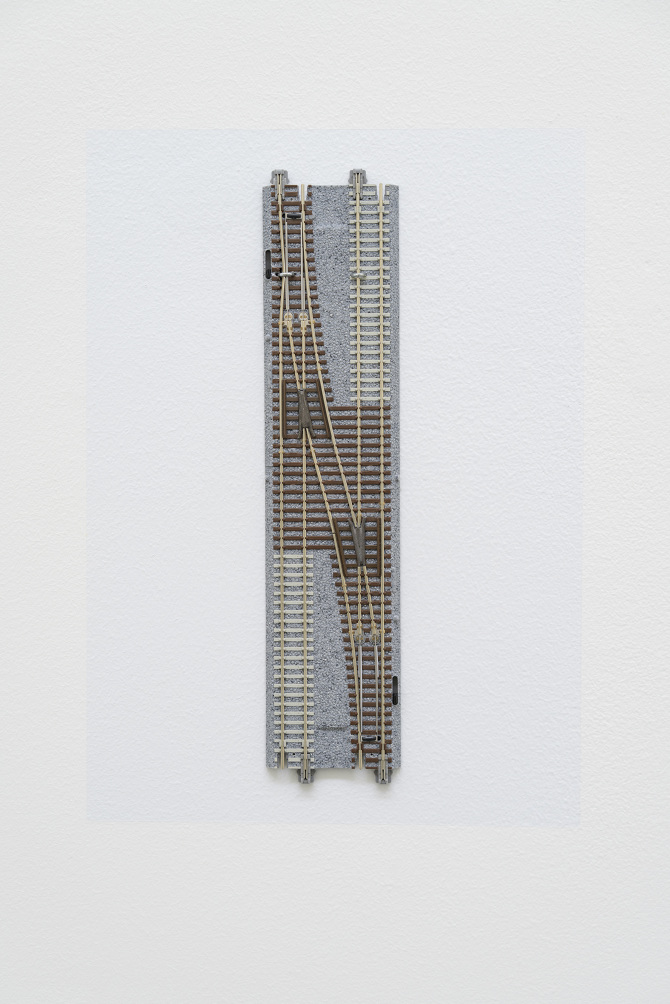
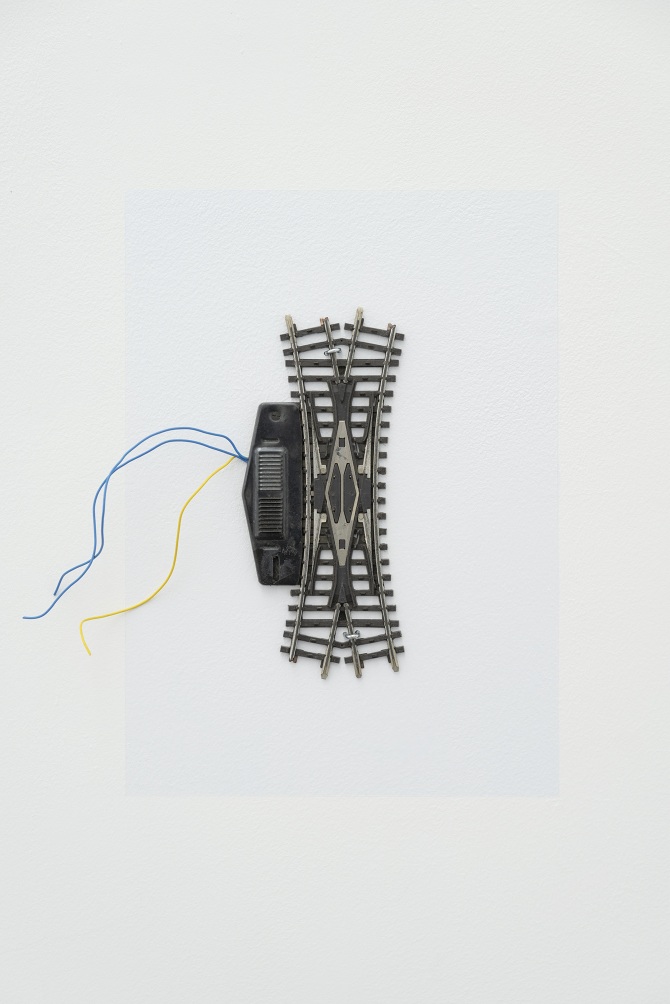
strata of (latent) practices unfolds as a sequence of model railway switches, installed vertically in the space of the Kunstmuseum Appenzell. Each switch is set on a white rectangle measuring 210 on 297 millimeters. While the switches have lost their familiar dimensions and orientation, their background anchors them in a semblance of universality, as both the A4 format and the railroad tracks follow the International Organisation for Standardisation (ISO) set standards.
In an in situ sequence shot, Toija calls us to embark on a train journey through what at first glance appears to be a void onto which to affix our subjectivities: our expectations, our memories and our respective normalities. A threefold shift takes place: from utilitarian infrastructures for guiding train wheels, to domestic leisure objects, strata of (latent) practices‘s switches are an analogy for the navigation of everyday life. From the rules necessary to the smooth running of a tangible system, the parts making up the work’s frieze are stripped of any function other than that of providing a space-time for reflection and decision-making. They become symbols of the tacit rules to which we decide whether or not to submit.
Usually, bundles of rails emerge from large train stations. In the case of smaller stations, at least, they are two parallel metal strips bordered by their ballast. In strata of (latent) practices, Toija focuses only on crossroads. Here, nothing else matters but the intersection of events. strata of (latent) practices invites us to reflect on the emancipatory and lethal potential of the rail.
Clara Chavan