

Toys, media, and products aimed at boys function as tools of emotional and behavioural conditioning. They promise excitement while quietly shaping ideas of masculinity, value, and self-image. These objects accumulate as internal matter, absorbed before language emerges and persisting as habits of thought. In Daniel Drabek’s practice, these materials return as psychic residues charged with memory and projection, carrying early identifications and fantasies and continuing to organise desire into adulthood. When artist Mike Kelley spoke about his own work, he emphasised that his toy-based constructions were not nostalgic monuments, but “something that an adult made”, thereby challenging the assumption that stuffed animals or craft materials automatically signify innocence or sentimentality. Drabek likewise constructs spaces and figures that remain suspended in a state of prolonged adolescence. One may speak here of a form of arrested development, a process that loops back into itself.
Drabek’s use of clip art functions as a contemporary form of the readymade. Stripped of authorship and affect, clip art operates as a visual shorthand learned early through screens, software, and advertising, internalised long before it can be consciously read. These images circulate as prefabricated symbols, designed for immediate legibility and frictionless communication, translating complexity into consumable signs. In Drabek’s work, clip art appears as a residue of this visual conditioning. The signs are generic, familiar, and emotionally vacant.
Across the exhibited works, this logic condenses into three registers: institution, emblem, and diagram:
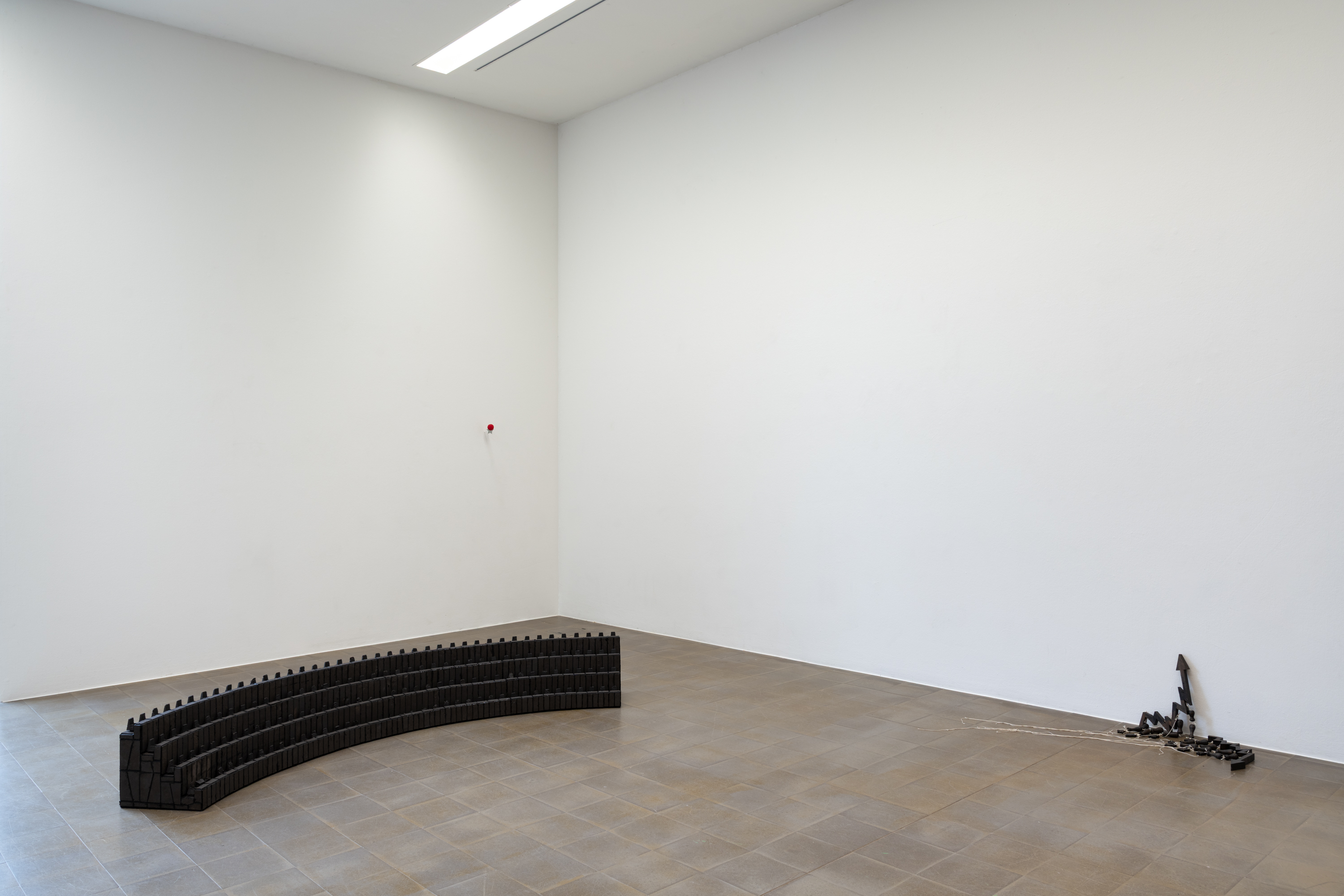
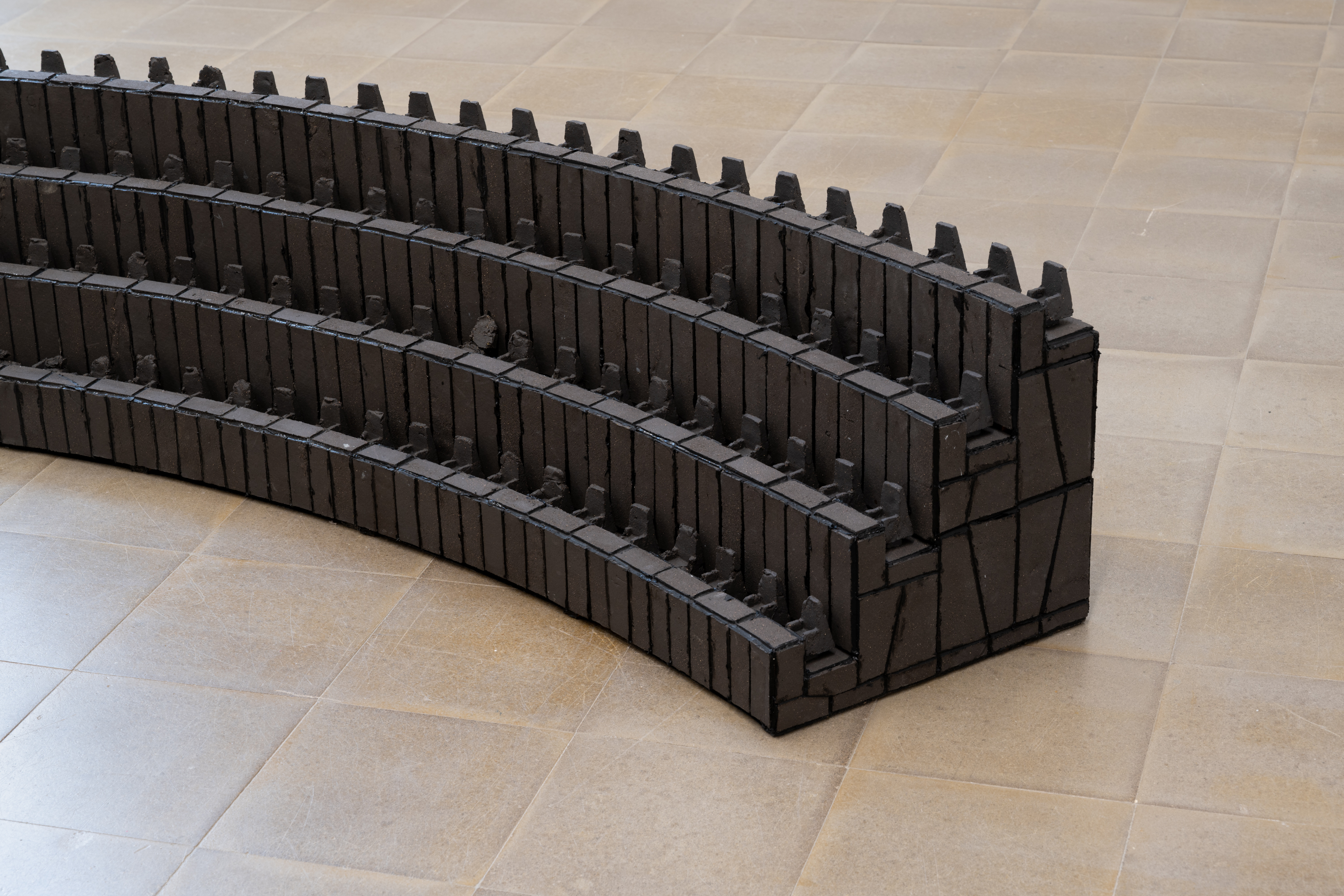
Parliament (2025) models political order as form, as a curved, amphitheatrical structure composed of serial elements that recall seating, ranks, and representation. Precisely because the object presents itself as legible architecture, it tips into a caricature of the political. Power appears not as discourse or action, but as a congealed arrangement, as a system that continues to function even in the absence of subjects.
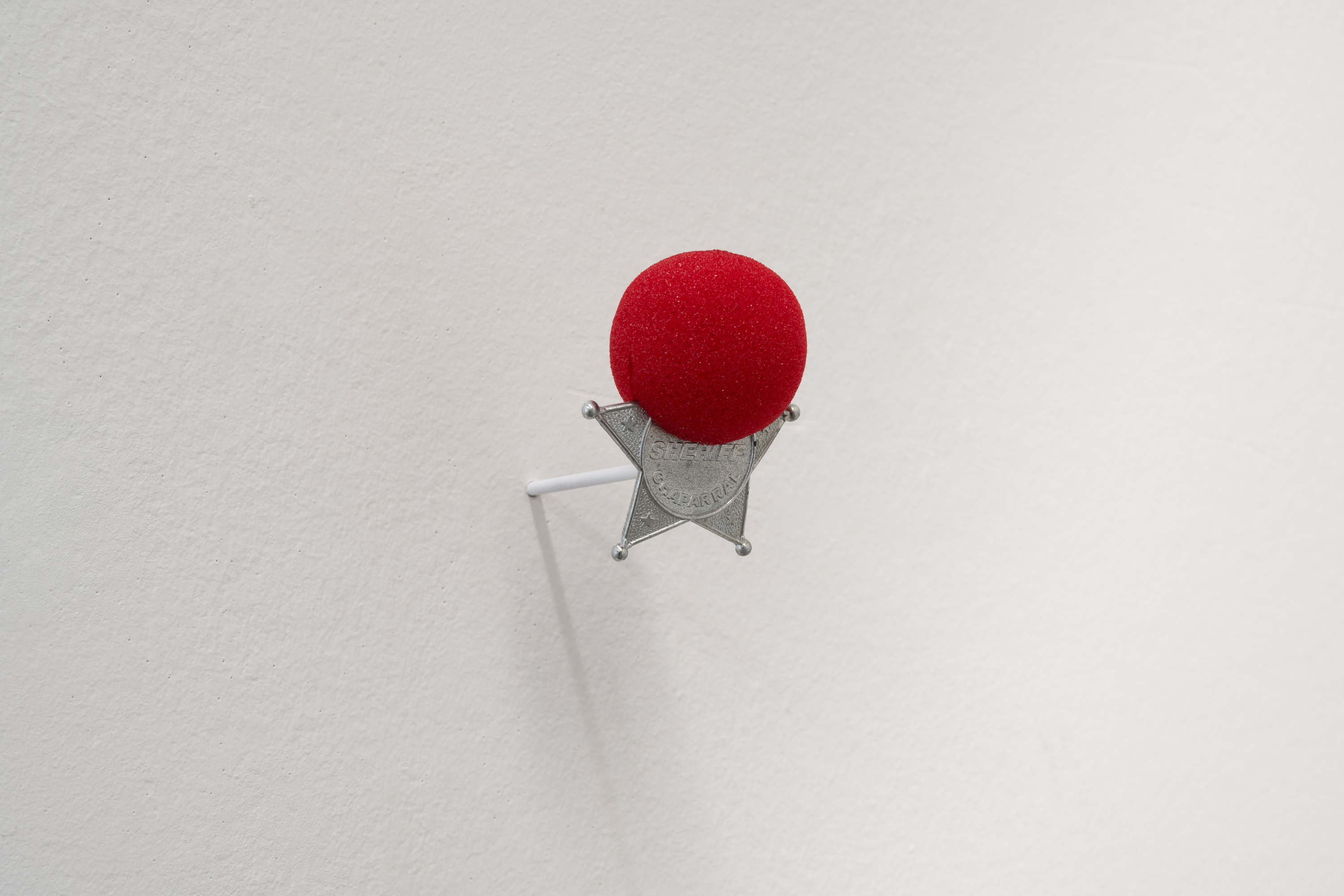
Untold Jokes (2025) operates through a minimal yet precise displacement. The sheriff’s star, an emblem of authority, becomes at once ridiculous and uncanny through the addition of a clown’s nose. More than a narrated joke, the almost accidental arrangement becomes a sign that devalues itself, a prop. Order and comedy do not sit alongside one another but inhabit the same object, as if every symbol of control already carried the conditions of its own parody.
With Comedy and Tragedy (2025), the classical semantics of comedy and tragedy are translated into the visual logic of statistics. Two marionette figures form two arrows, one moving upward, one downward. Rise and fall appear in the familiar grammar of financial charts, indicators, and economic curves. Yet these diagrams are exhausted. The arrows are composed of slack limbs, strings, and fragmented body parts, as if the system of evaluation had already consumed the body and transformed it into a pure directional sign. The oppositions of comedy and tragedy appear here as two standardised modes of the same structure: plus and minus, gain and loss, success and failure as automated affective forms that organise perception and desire before they ever become language.
Drabek’s works form images as iconic sign-relations. In the space between comedy and unease, schematic configurations emerge in which power structures, affective formations, and visual conditioning become visible as formal orders. The grotesque functions here as a mode of imaging through which meaning is structurally organised.
Eleonora Bitterli
(Translated from German)