

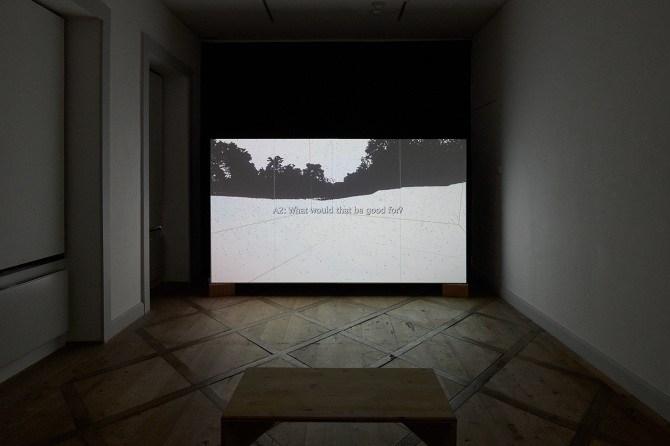
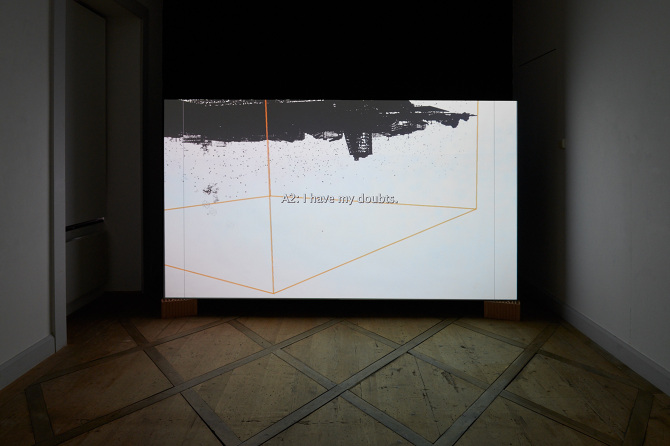
by the time, we were in the clouds, 2023
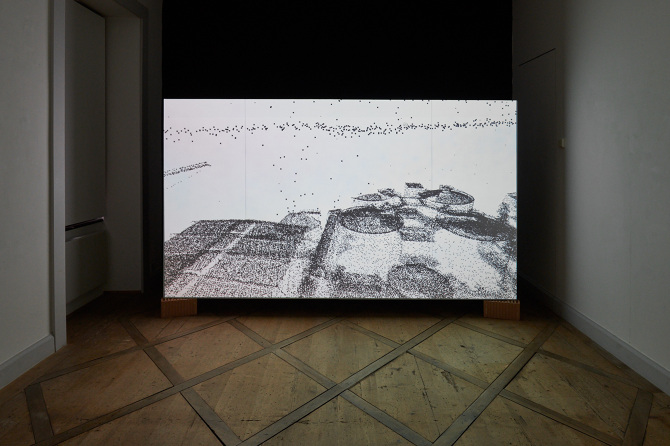
A point cloud describes an accumulation of individual reference points within a vector space, which in its partly disorganized structure takes on cloud-like forms. [1] For the collection of the point cloud data of the city of Zurich, which Aglaia Brändli virtually explores in by the time, we were in the clouds, a method of light distance measurement is used, which scans an environment or surface based on emitted impulses and represents it pictorially in the form of individual coordinates. [2]
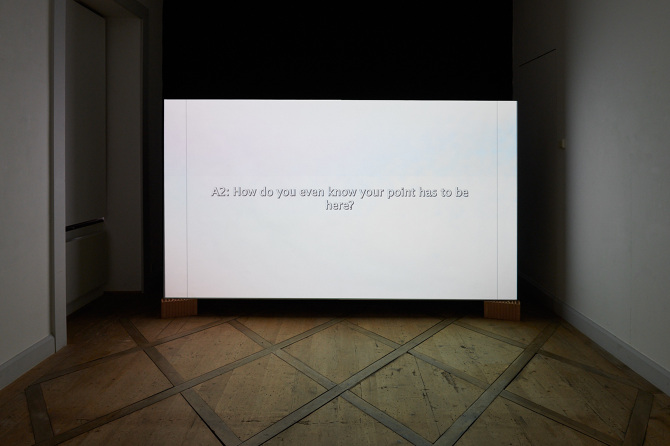
While concrete walls manifest themselves as opaque objects in dense black clouds, the glass Prime Tower, one of the city's landmarks, disappears almost completely. People, cars or animals are nowhere to be found in the recorded shots; rivers stand still. Like in a first-person shooter game, the artist maneuvers through abstract data landscapes. The seriousness of this research is underscored by the absence of sound. At the same time, smoke particles escaping from a chimney are depicted by a small set of individual reference points, suggesting a life outside the picture. This thesis is underlined by the intimate dialogue between two anonymous and yet familiar voices, which can be read in the subtitles of the video work. While A1 restlessly navigates through an almost incomprehensible amount of data, A2 humoristically and rationally comments on this undertaking. A2 asks about the origins of A1's meticulous research, tries to understand it, and simultaneously points out its limits, in the end posing an ultimatum.
In the work by the time, we were in the clouds, Brändli embarks on a journey of exploration in search of an understanding of her immediate surroundings. The meaning of objects of reference familiar to her is relativized; rather, the artist searches for their foundation. But the closer she gets to the core of things, the more clearly their incomprehensibility is revealed. Does every search ultimately end in a single pixel? Or is it precisely individual reference points that enable us to grasp and understand? There was a time, we were in the clouds results in a mood in which moments of hopeful and youthful curiosity alternate with those of a sober analysis with a nostalgic undertone.
Marius Quiblier (translation P23)
[1] J. Otepka, S. Ghuffar, C. Waldhauser, R. Hochreiter & N. Pfeifer (2013): Georeferenced Point Clouds: A Survey of Features and Point Cloud Management. ISPRS Int. Geo-Inf. 2(4), p. 1038-1065.
[2] H. Schmidtz (2021): Ein sechzig Jahre altes Laser-System macht plötzlich Weltkarriere beim selbstfahrenden Auto, Neue Zürcher Zeitung.
Photo credits: Margot Sparkes